Darryl Strawberry, Mookie Wilson reminisce to The Post about ‘bad boys’ 1986 Mets: ‘We were different’
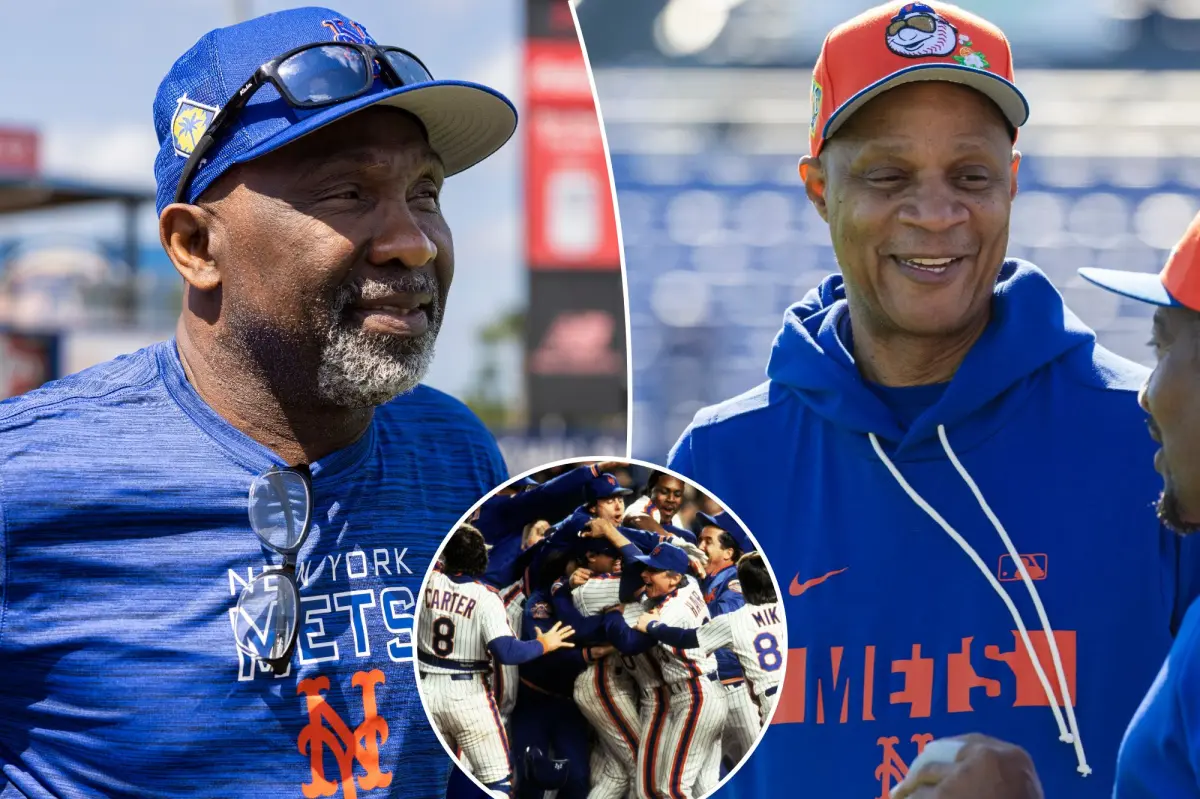
1986 Amazin’ World Series champions Darryl Strawberry and Mookie Wilson, joined by longtime Mets media exec Jay Horwitz, take a swing at some Q&A with Post columnist Steve Serby ahead of the Mets’ 40-year reunion of the championship team on Aug. 1 at Citi Field.
Read more Bullets fly at NYC hoops tournament, killing player and injuring two others: ‘We need more police’
Q: What did Davey Johnson tell you guys at the first spring training meeting in ‘86?
Strawberry: He just basically said we’re gonna win it all, we’re gonna dominate.
Wilson: (Laugh) Well, first of all I thought he was crazy. For him to say things about how bad we were gonna beat people, how we’re gonna dominate and this, that and the other, I’m thinking that this man is completely out of his mind at the time.
Strawberry: I think Davey was one of us.
Q: Mookie, describe your spring training eye injury during a rundown play.
Wilson: Raffy [Rafael Santana] was the second throw. I accomplished what I wanted was to get the second throw, I didn’t mean to catch it in my eye. There was no pain whatsoever. The only thing I remember is Gary [Carter] over me, screaming. The only thing I heard was Gary’s voice. I didn’t know how bad it was to be honest with you. I really wasn’t worried about playing baseball after that, I was worried about losing my eye. It was a scary time.
Q: How meaningful was that early four-game sweep in St. Louis?
Strawberry: I think that was really big for us to send a message to the Cardinals because they had beat us the year before. I think [Cardinals manager] Whitey Herzog said, “Nobody’s gonna catch them this year.” We just didn’t look back once we got going.
Q: Ray Knight punching Eric Davis at third base.
Wilson: We were not going to stand for any disrespect or excessive play against us. … Whether our player was in the wrong or the right, we were going to be there.
Q: Clinching the NL East at Shea.
Strawberry: I just remember the fans just going crazy. They hit the field. I ran straight out the bullpen. It was a great experience to be able to feel that because I always wanted to be a part of that. To look out the bullpen and see all the fans on the field and seeing the players later trying to get off the field, people snatching their hats and trying to snatch their jersey, gloves. It was just a crazy moment for all of us, and a scary moment at the same time ’cause you never know what could happen, you can get hurt in those particular situations.
Q: How much fun were all those curtain calls?
Wilson: Initially, I wasn’t too keen on the curtain calls, I think it was a little bit excessive showing the other club up. It became part of who we were, and actually it was part of our personalities. Davey never put restrictions on that ballclub. It allowed us to be who we were. I think it helped us to relax against the pressure because remember now, we were supposed to win, and that’s a lot of pressure.
Q: What’s the longest home run you saw Straw hit?
Wilson: The one he hit in Montreal. … It’s a good thing they had the roof there (laugh), no telling where that thing would have gone!
Q: What was your slowest home run trot time?
Strawberry: Probably [World Series] Game 7. I had a little chip on my shoulder about being double-switched in Game 6. Just trying to get back at Davey. It was just childish, 24 years old, you think you’re all that. He never really threw anyone under the bus to the media, and he just allowed us to be players and play. Nothing got under his skin. He was tough as nails, and I respect him for that.
Q: What do you remember thinking as you ran the bases?
Strawberry: This is for you, Davey. … When I get to home plate, Ray Knight grabs me and tells me, “Make sure you go over there and shake Davey’s hand,” and I told him OK, and I did shake his hand, gave him [a high]-five once I got in the dugout and everything.
Q: What was it like playing behind Doc Gooden?
Wilson: A vacation (laugh). … Many days I found myself being a spectator. It wasn’t just a game, it was an event.
Strawberry: It was pretty boring standing around in the outfield, you’re looking and you’re watching the excitement of the fans and the excitement of the guy with the K’s up in the corner, and you think about it, 19, 20 years old dominating major league hitters like Mike Schmidt and [Andre] Dawson. … You just realize that Doc was gonna be pitching, you weren’t gonna have a lot of running to do. It was pretty incredible to watch a guy be so young and have such great command. And the poise that he had on the mound. You’re just like a fan, you’re watching and you can’t believe what you’re seeing.
Q: Darryl, describe your Game 3 NLCS three-run home run off Bob Knepper.
Strawberry: I just remember Keith [Hernandez] being on base and telling me to keep my shoulder in more than anything. I got a fastball at the beginning and I just got the head out on it and hit it over the right field fence and tied the ballgame.
Q: Carter’s walk-off Game 5 single in the 12th.
Strawberry: That was really big to get a walk-off like that and give us that feeling that we just didn’t want to get to a Game 7. … We just didn’t have a chance against [Astros ace] Mike Scott. I don’t care what lineup we put out there, we just were not going to beat him. He got in all the players’ heads with what he was doing and everything.
Q: How many scuffed balls did you guys collect when Scott pitched?
Wilson: I counted a dozen. Straw hit the nail on the head: We faced tough pitchers before, but they weren’t in our heads. It would have been trouble. … If we could have just gotten over the fact that he was doing something to the ball and just play, we would have been OK. When you got the whole team worried about it, then you got problems. There was no really enforcement of that like they do now. Yeah, we complained — every day, every pitch — but it didn’t do any good.
Q: Top of the ninth, Game 6 of the NLCS, down 3-0, how nerve-wracking was that?
Strawberry: I remember our team that season we never gave up, no matter how many runs we were down. It was a team that would just battle. You gotta get the last out, it’s not over until you get the last out. They had every opportunity, they had every excuse they want to make, but they did not get that last out.
Q: What were your emotions when Billy Hatcher hit the game-tying home run in the 14th?
Wilson: It was stressful, man. That is the one game that I wanted to end so we could start fresh another day. I was exhausted. Mentally, I had nothing left. At that point, I was willing to take my chances with Mike Scott ’cause I had nothing left in that game.
Strawberry: I said “Oh my god, this is gonna be some kind of ballgame here,” because we thought we had it there. We were completely drained. It was just heartbreaking when you saw it. I still didn’t want to face Scott the next day. I wanted to win that game, I can tell you that right there.
Q: Before that Game 6, did you guys check out of your hotel?
Horwitz: I think we did check out.
Q: That would tell me the Mets expected to win that game.
Wilson: Yeah.
Strawberry: Yeah, we kind of expected to win that game. But we didn’t think it would be that long (laugh).
Q: What were your emotions when Jesse Orosco struck out Kevin Bass in the 16th and threw his glove in the air?
Wilson: Relief. That was the Game of the Century. I still say that was probably the greatest game I’ve ever been a part of.
Q: What were your emotions when you realized you were going to the World Series?
Strawberry: To have that moment with the group that we had was very special. It was a team of destiny, it was a team of whatever craziness you want to call, but we had a lot of dawgs on that team that would fight and do everything to protect what our team was about, and when you get to that final moment of that last out and you know that you’re going to the Series now, that was big for us. But we were completely drained, and I think that’s why we went down 0-2 when we got to the Series ’cause we had nothing left after that Astro series.
Q: How crazy was that flight back home?
Strawberry: We made it back.
Wilson: I will say this: Whatever celebrations we had on that plane, we deserved it.
Strawberry: Right.
Wilson: That team did not disappoint the fans, did not disappoint Major League Baseball, and no matter whatever city you went to, people wanted to see us play.
Strawberry: We were like rock stars, it was like a rock band coming into town. Everybody wanted to see the Mets, the bad boys. Some of ’em think they’re pretty over there and too cute, some of ’em are showboat … it was just a team that was different. You’ll never see a team that good that played the game the way we played. We played the game well, we played it hard … and we would put our knuckles on you, too. We just didn’t play around, you just didn’t want to play around with us.
Q: What was the craziest thing you saw on that flight home?
Strawberry: I saw food fights. I saw a little bit of everything. … You had a bunch of scumbags on the team that were just drinking and throwing stuff at each other. You didn’t want to come to the back of the plane, just put it like that. It was a different breed of players back then when you come back there. But we deserved it. We finally got to this place that we thought we were supposed to get to, and it wasn’t easy, it was a dogfight.
Wilson: I think people fail to realize that there was a lot of family on that plane. You had the coaches, you had the family section and you had the scumbutts.
Strawberry: They had their wives, too. They were in the food fight, too.
Wilson: (laughing) A great time.
Q: But then you lost the first two games to the Red Sox at Shea.
Wilson: Straw said it perfectly, that we had nothing left. And I’ll go a bit farther: I think we took Boston for granted. I didn’t think Boston could even be on the same field as us, to be honest with you, I thought when we beat Houston, we beat the team that we needed to beat.
Q: Game 3 with Bobby Ojeda on the mound.
Strawberry: We were supposed to have a workout and we didn’t have a workout. I think Davey realized that we were drained and were down 0-2. I don’t think we were really worried, we were ready to play. Bobby O. always was a big-game pitcher, going against his old team, and he shoved it down their throat.
Q: You heard taunts in right field in Game 5 at Fenway Park.
Strawberry: That’s a terrible place to play. Their fans got a lot to say about you when you’re out there, it’s a different breed. It’s kind of like Philly when you’re playing in Philly. … You can hear the conversations of people saying a lot of things, and flipping me off and grabbing their you-know-what and telling me how much I suck. People say, “What did you think about it?” I say, “Well, at least they know I’m in the ballpark.”
Q: Game 6, what did you think when the guy parachuted onto the field?
Wilson: I said, “That’s so New York (laugh).” Something crazy was going to happen. And I thought it was funny. Anything that happened at the ballpark was a reflection of who we were. Lenny [Dykstra] might have parachuted in (laugh). It didn’t bother us. I don’t think anything distracted us at all because we were such a free-spirited ballclub and we took things in stride.
Q: You were one out from losing.
Strawberry: It was hard to beat us, it was hard to end the game. We hated losing. I was out of the game and I was in Davey’s office with Keith and we’re sitting there watching the game unfold and Keith was like, “OK, nobody move.”
Q: When you came to the plate before the wild pitch that tied the game, what do you remember thinking?
Read more Ex-Pentagon UFO honcho claims photos show monolith-like structures on moon
Wilson: I remember just going to home plate and I just blocked everything out. The good thing about it is, I knew Bob Stanley, I faced him before, so I knew what he was going to try to do. I didn’t put any pressure on myself saying I had to get a hit, I had to do this. It was just, do your best, put your best out there. I was determined to put that ball in play. I was not gonna give the umpire an opportunity to call anything close to a strike. I was just battling, man. I didn’t hear anything, I didn’t see anything. It was just me and the pitcher, that was it.
Q: The wild pitch that brought Kevin Mitchell home with the tying run.
Wilson: I was telling him to slide, not realizing that he could see the ball.
Q: What are you thinking when you hit the ground ball that got by first baseman Bill Buckner?
Wilson: I can’t tell you what I said (laugh). I was really upset because he really threw me a good pitch to hit. That’s the best pitch I had to hit the whole at-bat, and I rolled over it, man. That should have been a hook down the line down that corner for a triple, and I rolled over it, man. Now I gotta run. And I remember watching the ball bounce, this slow roller, I probably coulda beat the ball to first base, to be honest with you. And I’m just running hard, and then when the ball went between his legs, the same thing I said when I hit it, I said it again. … I was just in shock that he actually missed that. My focus was beating Buckner to the bag. I knew it wasn’t the last out of the whole series because the score was tied. So in other words, I was playing with house money.
Q: Paint the scene for me in the manager’s office with you, Keith and coach/scout Darrell Johnson.
Strawberry: We kind of knew the kind of team that we had that could come back and do something like this. And that fight was in ’em, you could see that fight in everybody battling. And Mook battling that at-bat was big before that ground ball to even happen. When you see the ground ball and you see how far he’s playing back, and Mook’s getting down that line, and you don’t see a pitcher covering, you could think to yourself that he knew inside of himself it’s gonna be a battle for him to get to first base because he’s had bad knees and he’s got bad hips, and people thought he should have been out of the ballgame, but I’m quite sure he wanted to be a part of the celebration, and he felt like he was gonna be able to beat Mook to the bag, which I didn’t think he would, and he came up before he even got the ball trying to get to the bag, and that was it. It was a celebration, it was a shock, it was a miracle, and we knew right then we still had life, we still had another chance, another day to come back and try to finish off what we started.
Q: Then came the rain delay.
Wilson: I was disappointed because we had momentum and I thought the rain delay was going to calm the excitement down and then we might lose that game. Boston was defeated. They were done dealing, and I thought the rain delay would give them a chance to regroup. But even after the rain delay, in all honesty, I knew that we were gonna win Game 7. There was no way we were gonna lose Game 7. No way.
Strawberry: I felt it took away from what we had just accomplished the night before. I felt like we still were gonna win that game. We had that intensity level ready to be ready for it no matter what. We had been through this long season, and realized that we have gotten this far to one game left, and we just gotta make the best out of it, we gotta go out there and we gotta play just like any other game.
Q: You fell behind 3-0.
Wilson: At no point in that game did I ever say that we weren’t gonna win. And when I looked into the Boston dugout, they’re waiting for something crazy (laugh). … They were never celebrating over there! I remember looking at them, I’m saying, “They’re done.”
Strawberry: We’d been down many times in the course of that season, and it’s just a group of guys that really know how to play baseball, and really know how to come back and win. … And it’s probably the best team I’ve ever played on that actually knew how to come back and win ballgames. Being down 3-0 was no big thing to us.
Q: Ray Knight hits the go-ahead home run.
Wilson: It wasn’t surprising that Ray hit the home run. Whenever we did something, it wasn’t a surprise to me, it was expected. Somebody was going to do it.
Q: What did you think of Straw’s slow home run trot in the eighth inning?
Mookie: He hit many home runs that year, but that one was special, man.
Q: To this day Doc regrets missing the parade, right?
Wilson: That’s the one regret he regrets. That’s not me putting words in his mouth, that’s him speaking to me about it.
Q: What was that parade like?
Strawberry: Special. Something that you couldn’t imagine. But just so unreal, so many fans come out on that day and celebrate us. It was a wonderful time for us to be celebrated. They embraced what the New York Mets were. We were really the back page over the Yankees in the town. We came out of nowhere and all these people embraced the Mets, and it was really cool.
Q: Whatever comes to mind: Len Dykstra.
Strawberry: Everything (laugh). Just crazy as ever. Would do anything to win.
Q: Wally Backman.
Wilson: You want him in your corner. Little man with a big attitude. Him and Lenny were pretty much two of the same guys. You wanted those two guys at the top of your lineup.
Q: Keith Hernandez.
Strawberry: Mr. Clutch. He would come through big-time in big situations.
Q: Gary Carter.
Wilson: Gary was the ultimate optimist. No matter how bad things were going, he always had a smile, which was the one thing that we as ballplayers resented Gary about when he was with the Expos. But then when he came to us we learned to appreciate. … You’re never gonna meet anybody that’s more positive than Gary Carter. Nobody.
Q: The 1986 Jay Horwitz.
Strawberry: I would have to say he’s probably the most special person that we had in the organization. He took care of everybody. Whatever occurred, he protected the players. You have nothing but total respect for him. Just a class act all the way around. When you didn’t want to come out and talk to the press, he made me come out.
Wilson: Jay was a guy that you knew as a player that he always had your interest at heart. Always. He knew what was good for you when you didn’t know what was good for yourself when it came to the PR part of the game. He had a balancing act that he had to worry about what was good for the players and good for the club, and he was always able to walk that line … integrity was unmatched.
Q: Mookie, you have a book “Faith” coming out.
Wilson: It’s gonna be kind of mixing gospel with baseball, my experiences in both areas of my life.
Q: Darryl, for your book ‘Another Life,’ what was it like speaking to Death Row convicts?
Strawberry: It was pretty cool. We don’t know what happened to ’em. It’s not my job to go in there to try change them, it’s my job to go in there and love on them to encourage them, more than anything. They have done some heinous crimes, and they are supposed to be there, but at the same time, we have a gift that’s been given to us to go back and love people, care for people right where they’re at.
Q: Mookie, how proud of Legacy Catering are you?
Wilson: Of all the things that I’ve done in my life, Legacy Catering is something that was created through my family. It was things I’ve learned from my parents, and I just know that there’s not many ways that you can honor your parents other than having their name, but Legacy goes a little bit farther than just having the Wilsons’ name, it’s part of who we are as a family and what kept us together, and believe it or not, food is something that kept us together. My mother found a way to produce foods out of nothing and made it taste good (laugh). She passed that same gift to all her kids, and we decided that we wanted to keep it going.
Q: What made the ’86 Mets the ’86 Mets?
Strawberry: I would sum that up as the great chemistry that we had together. You didn’t always have to get along. We stepped on the field, you didn’t want to mess with us. We were a different breed of players. When you did something to one of us, you did it to all of us, that’s just the way we felt. We were gonna make you pay for it. You could feel the fact that this is a group here where you just don’t want to play around with because they’re serious about their business, they’re serious about winning, and they’re serious about their teammates, and they have each other’s back on every situation. I think that’s what made us so special more than anything.
Access the Mets beat like never before
Join Post Sports+ for exciting subscriber-only features, including real-time texting with Mike Puma about the inside buzz on the Mets.
Try it free
Wilson: Twenty-five personalities. One goal. We didn’t have to always get along, and we had a few little scuffles and confrontations in the clubhouse — but that was in the clubhouse. When we stepped on the field, it was everybody for one. To this very day, every one of ’em is a very, very close friend because of that togetherness that we had. I would go on the road and I took my son with me a lot. I never had to worry about babysitting because he was always with somebody. They had a genuine love for each other, man.
Q: Where do the ’86 Mets rank in Major League Baseball history?
Strawberry: At the top. Nobody would have wanted to play us. We were different. I played on the ’98 Yankees. There was no weakness on the ’86 Mets, I can tell you that right now. It was gonna be tough to beat us. We’re right at the top of what a championship team looks like — a team that had more fight in it than I ever been on before. These are the guys that had the fight in ’em, the grit in ’em, the grind in ’em, and it was special to be a part of that.
Q: So you think the ’86 Mets would have beaten the ’98 Yankees.
Strawberry: Of course. A lot of guys over there were great, and a lot of friends over there. But I just think we had a different type of focus of what we were when we hit the field — we were bad, man. We were some bad boys, I can tell you that.
Wilson: This team was probably one of the most complete teams. We had starters on the bench. How many teams were predicted to win it all and dominate and do it? Not many. The top three.
Q: That team exemplified New York, right?
Wilson: We definitely had the New York personality. New York is a blue-collar, fight-to-the-end city. They don’t give in, they will fight for what they think they deserve. A player comes in, there’s certain things you had to do when you come in this clubhouse, you don’t come in here thinking you own the world.
Q: Mike Tyson was a big ’86 Mets fan, right?
Horwitz: He called one day and he said every time he turned on the TV, one of the guys was in a fight. He admired our style of play, he wanted to meet the guys. Mike was officiating behind home plate between Darryl and Doc, we had the boxing gloves.
Wilson: We were different, man, That’s what I’m proud of, that we left a mark on MLB.
Q: When will the Mets win another championship?
Strawberry: I think they are in transition. I think they are in the rebuilding phase for themself, and sometimes that has to happen before you can win again.
Wilson: I think it’s about identity. You have to have an identity to have a cohesive group. That ’86 team, we’d been together for a couple of years before we won in ’86. The Mets are in transition right now, and it’s gonna take a little time. It takes more than one great ballplayer to win.
Q: Hard to believe it’s been 40 years, right?
Strawberry: Yeah, 40 years and they still haven’t won anything, right?
Wilson: Still trying (laugh).
Strawberry: (laughing) They’re still trying. Yeah, it’s hard to believe it’s been 40 years. We were a family, and you just don’t see that with every team, though. It’s special when you see the guys because you remember what we all went through together. You never forget that. To accomplish a championship, it’s very hard to get into the winning circle, and we were able to do that.
Q: Over 40 years, you learn a lot of life lessons.
Strawberry: Never give up. Never quit. No matter what has been said or done in your life, it’s part of your journey, and it’s part of your story. It doesn’t mean you quit and give up just because you went through some trials and tribulations in life. It means that you get up and if you don’t quit, you don’t know what’s on the other side. That’s what happens to most people, they give up too soon and they miss out that there’s another side of life. And not just being a baseball player, being a man, I think, more than anything. You have to learn these things in life and you take ’em with you and you use every part of it to become the man that when your career’s over you can look back and you can say, “I’m really blessed and I’m really thankful that I went through everything.”
Wilson: Never abandon or deny who you are. When you start doing those type of things, you don’t learn, you don’t grow. You stay true to yourself, you can’t go wrong.
Read more For peace in Ukraine, don’t give Putin an off-ramp — force him into a dead end