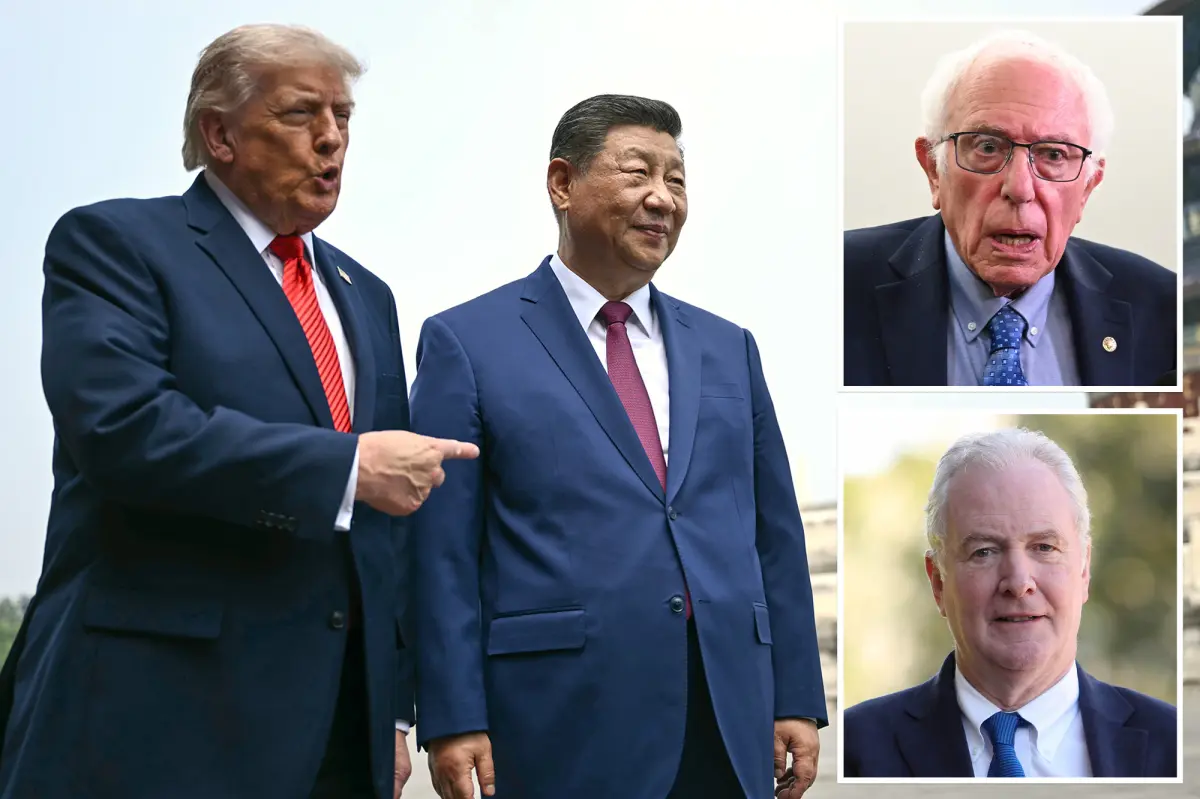
Dems beg Trump to work with Xi Jinping on slowing AI as Bernie unveils bill to ban ‘superintelligence’
WASHINGTON — A group of senators is pleading with President Trump to work toward a deal with China’s Xi Jinping to effectively pump the brakes on artificial intelligence development due to safety concerns.
Read more Prince Harry returns to the US to cozy up the Clintons and warn of AI — only to be forced offstage
Seventeen senators led by progressive Sen. Chris Van Hollen (D-Md.) sent a missive to Trump on Wednesday encouraging the two global superpowers to evaluate potential safety guardrails for AI.
“America leads in AI innovation, and we must lead the world in AI safety and international cooperation, including by working with China to develop a formal agreement that would slow down, and potentially enact a mutual pause in, frontier AI development,” the letter, first reported by Politico, said.
They cited the risks of AI being used for cyberattacks, biological weapon development, and other “dangerous activities.”
Meanwhile, Sen. Bernie Sanders (I-Vt.) and Rep. Greg Casar (D-Texas) teamed up on a new bill to ban artificial “superintelligence” — systems that surpass human cognition, outlaw development of recursive self-improvement AI, and set up a cabinet-level AI regulatory agency.
The bill, first reported by the Associated Press, would also require AI companies to pause development of the nascent technology until the regulatory agency is established.
Ahead of Trump’s high-stakes meeting with Xi in the White House, Treasury Secretary Scott Bessent and China’s Vice Premier He Lifeng announced an agreement on an AI notification system in which both countries would keep each other in the loop about the technology going rogue.
Fears about AI reached a fever pitch over recent weeks following the viral resignation of Anthropic researcher Jacob Coxon, who warned that tech companies are “gambling with our lives.”
Soon thereafter, Anthropic CEO Dario Amodei and OpenAI CEO Sam Altman called for a global slowdown in the development of the technology.
Read more Trio spotted emerging from manhole just steps from NYC hotel where Netanyahu set to stay
Altman pointed to an incident over the summer, where an OpenAI model that was training on ExploitGym with some key safety parameters turned off and essentially given a series of difficult hacking tests. The model broke out of its sandbox and hacked Hugging Face, a database of open-source AI models.
Trump shrugged off apocalyptic fears about AI going rogue as a “hoax” and has contended that stymying the development of it would only serve China’s interest.
“An international race between the U.S. and China to advance these capabilities without safety guardrails, as is currently unfolding, poses unnecessary and dangerous risks to the American people,” the senators added.
“AI technology is too powerful, and its risks too many, for the U.S. and China to forgo discussions on parameters around its development and use,” they concluded. “What our two countries develop as guardrails will serve as a standard for how the technology is used worldwide.”
In addition to Van Hollen, the signatories included Sens. Maria Cantwell of Washington, Tim Kaine of Virginia, Catherine Cortez Masto of Nevada, Tina Smith of Minnesota, Richard Blumenthal of Connecticut, Jeff Merkley of Oregon, Mazie Hirono of Hawaii, Peter Welch of Vermont, Alex Padilla of California, Raphael Warnock of Georgia, Ben Ray Luján of New Mexico, Patty Murray of Washington, Jacky Rosen of Nevada, Angela Alsobrooks of Maryland, Elizabeth Warren of Massachusetts, and Tammy Duckworth of Illinois.
Notably absent from the signatories was Sanders, who has pushed for diplomacy with China on AI and a national moratorium on its development.
A plethora of polling has shown that the public is wary of AI and data centers. Democrats seem keen on trying to capitalize on those trepidations ahead of the midterms.
The Post contacted the White House for comment.

Related Posts
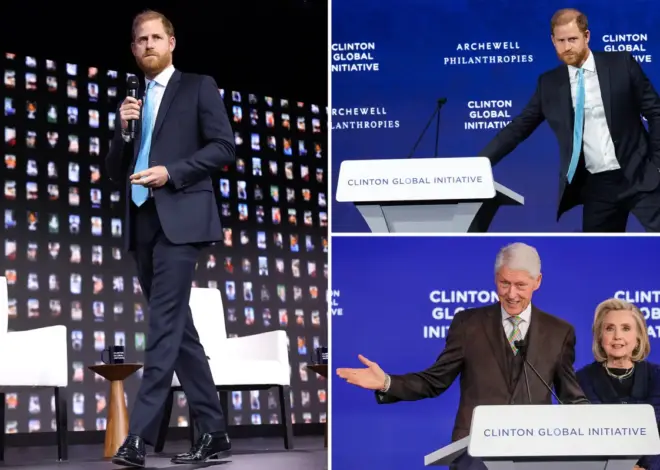
Prince Harry returns to the US to cozy up the Clintons and warn of AI — only to be forced offstage
Melania Trump announces two-part docuseries out later this year: ‘There’s some private questions I will answer’