US airman rescued from Iran shares unbelievable tale of survival with ’60 Minutes’: ‘Most terrifying thing I’ve ever seen’
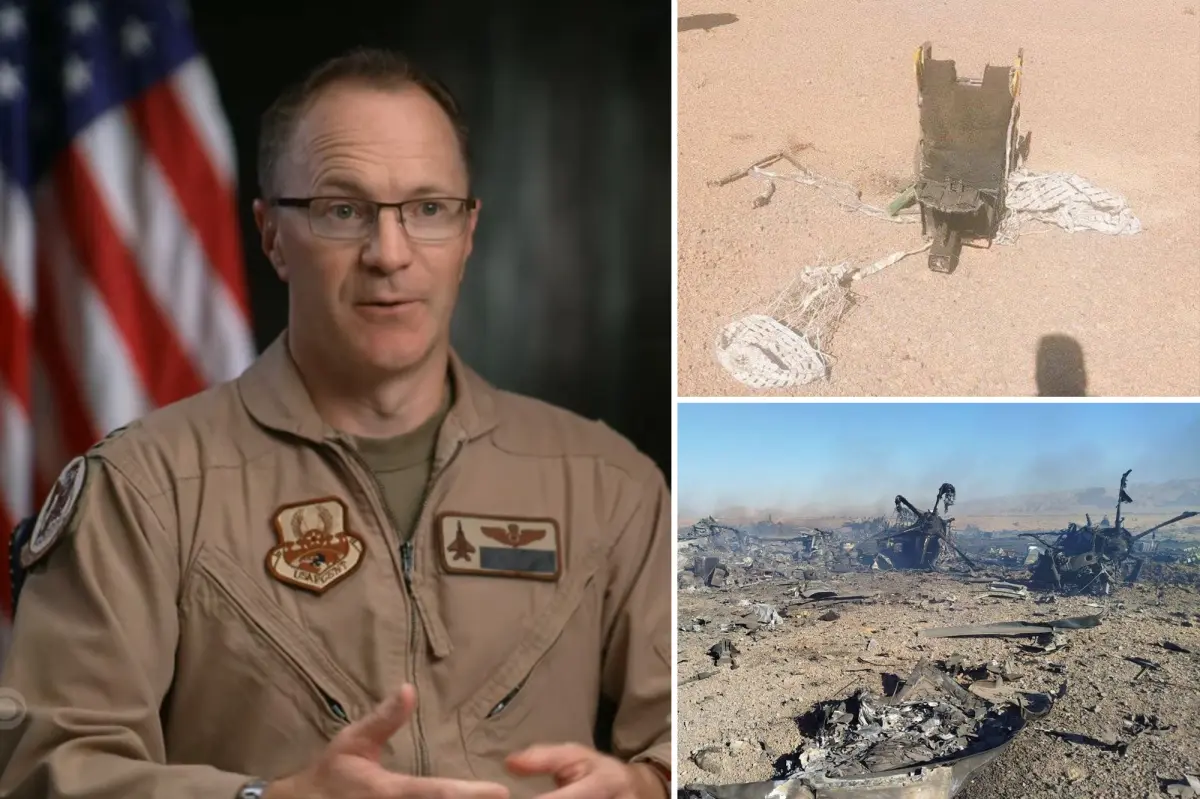
The US Air Force colonel rescued from Iran in April revealed Sunday that the “most terrifying moment” of surviving nearly two days on enemy lines was plummeting to earth with a damaged parachute after his F-15E Strike Eagle was shot down.
Read more Malik Nabers making long-awaited Giants return in enormous boost
The weapons systems officer — identified only by the mission call sign Dude 44 Bravo — spoke publicly about his unbelievable tale of survival for the first time in an interview with CBS “60 Minutes” host Norah O’Donnell for the show’s 59th season premiere Sunday evening.
Bravo’s plane was shot down by an Iranian with a shoulder-fired missile on April 3, and crashed in the Kohgiluyeh and Boyer-Ahmad province in the southwestern part of Iran near Iraq.
The impact of the missile was like “getting hit by a freight train,” Bravo said.
His crewmate and pilot, callsign Alpha, ejected them both from the $30 million jet, but Bravo’s parachute failed to inflate, he said.
“My parachute was damaged in the initial attack. At one point, when I looked up and saw no parachute, that was the most terrifying thing I’ve ever seen,” the heroic officer told O’Donnell.
Bravo said that he estimates he was falling to the ground at somewhere between 70 and 100 miles per hour.
“I wasn’t focused on the speed at which I was falling. I was instead focused on trying to correct the problems that were in front of me. And doing anything I could to unfurl or pull pieces of the parachute loose,” he said.
The tough-as-nails Airman suffered a broken back, a broken arm, a broken shoulder, and a sprained ankle, as well as cuts to his head and face.
While his crewmate was rescued by US forces within hours, Bravo was forced to survive nearly 50 hours stranded with his severe injuries and no water or food.
Despite it all, Bravo managed to avoid detection by nearby Iranian fighters who placed a $60,000 bounty on his head.
The colonel even climbed a 7,000-foot ridge and hid in a crevice in the Zagros Mountains while awaiting rescue in the treacherous desert.
“I had injuries, but we all train to adapt and overcome the things that we’re faced with,” he said. “I moved as quickly as I could, despite the injuries, away from the place that I landed.”
“Never let a lack of motivation put you on Iranian TV,” Bravo said.
After night fell on his first day in Iran, the weapons systems officer sent out a short, impactful message over the radio back home that US authorities initially thought was an attempt to trap them.
Read more Exclusive | NY Dem House candidate modeled for XXX-rated BDSM ads while serving in National Guard
“When I got to the moment where I could review and think about all that I’d gone through, I sent, ‘God is good,’ as a recognition of all that he had brought me through,” Bravo said.
US Defense Secretary Pete Hegseth told “60 Minutes” that he was woken up in the middle of the night by news of the downed crew.
“Whether they’re alive or not, we’re going to go get them,” Hegseth said.
The pilot, Alpha, hit the ground roughly five miles away from Bravo and was rescued by US Special Operations forces within half a day in a risky daytime raid, sustaining only minor injuries.
The massive rescue force, in which American helicopters took fire, was unable to find Bravo and had to launch a second mission the following day.
“That was a really tough decision,” Hegseth said. “I’ll never forget, you know, being in the situation room and saying, ‘OK, I guess we’re gonna roll 24,’ which means, ‘Hey, Bravo’s going to be out there for basically 24 hours more.’”
The Airman was finally rescued in a complex operation involving dozens of aircraft and MQ-9 Reaper drones as the sun rose on Easter Sunday.
The operation involved two large search-and-rescue planes on a makeshift desert strip, from which they sent small “Little Bird” helicopters to locate the airmen on the ridgeline.
After his miraculous survival, Bravo said seeing his rescuers was “one of the greatest moments” of his life.
Fifty hours after the jet was shot down, Bravo was able to call his wife in the US and let her know he was safe.
“I was really proud of her and grateful for the strength that she showed,” Bravo said.
He credited his survival to all those involved in the mission.
“It’s a story of the teamwork, the training, of the faith, of the decisions and the leadership to do something that will live in history as an example of what America’s willing to do, in order to uphold our promise and leave no man behind.”
“I will be thankful to my dying day for my pilot and crewmate Alpha for saving our lives and ejecting us,” he added.
Read more NYFW honcho tackles PETA protesters in wild caught-on-video scene in front of A-listers

Related Posts

Catholic parents fighting for custody of their trans teen whose school helped to transition without their knowledge: report

Elizabeth Holmes’ X account posts cryptic message and glam kissy selfie of imprisoned fraudster