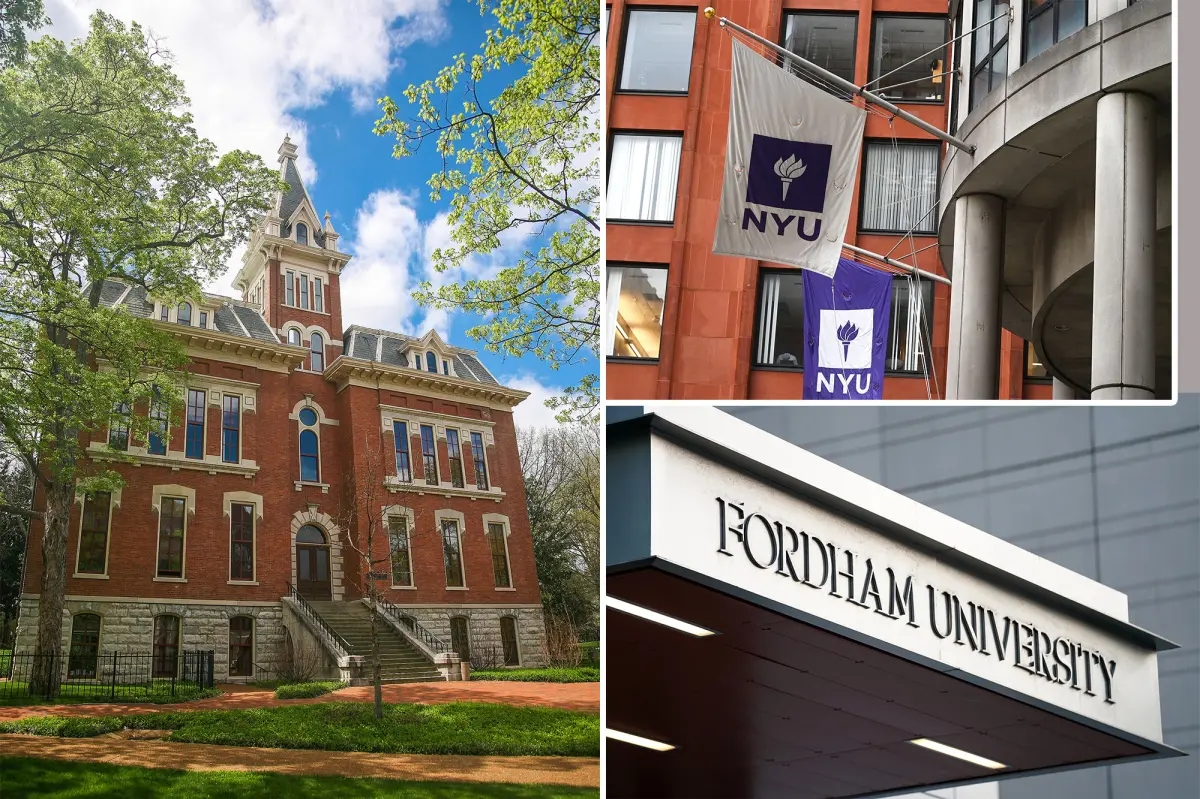
15 colleges now cost $100k+ per year — and almost none of them are worth it
Caveat emptor!
The number of colleges that cost more than $100,000 per year to attend has sky-rocketed this year — but few of these pricey schools offer a strong return on investment, according to rankings.
Read more Athletic reveals findings on Dianna Russini-Mike Vrabel relationship investigation: ‘Uncomfortable’
Fifteen higher ed institutions cracked the six-figure pricetag this year, up from a just two the previous year, according to an analysis from the the Washington Post.
That means students at those schools will be shelling out nearly a half-million dollars over four years of schooling.
Another another nine colleges were also mere dollars away from breaking the six-figure mark, data from the Princeton Review showed.
The most expensive schools in the US are:
- Harvey Mudd College, Calif. — $104,512
- Duke University, NC — $103,975
- University of Chicago, Ill. — $103,821
- University of Southern California, CA. — $103,162
- Barnard College, NY — $103,000
- Washington University, Mo. — $102,260
- Smith College, Mass. — $102,226
- Fordham University, NY — $102,188
- Claremont McKenna College, Calif. — $101,990
- Vassar College, NY — $101,051
- Wesleyan University, Conn. — $101,030
- New York University, NY — $100,998
- Georgetown University, DC — $100,864
- Colgate University, NY — $100,224
- Haverford College, Penn. — $100,026
Ivy League schools Brown, Columbia and Cornell were close behind, each charging just under $100,000 per year.
Despite those huge prices, separate statistics raised questions about what the money is buying — none of the 15 most expensive schools appeared equally high in college rankings of the best returns on investment.
California’s prestigious Harvey Mudd College rated most-expensive at $104,512 in the Princeton Review — and came in 50th in a Wall Street Journal assessment of financial return on investment.
The WSJ analysis calculated the estimated earnings of graduates from each university — and compared it against the cost of attendance.
The University of Chicago — third most expensive at $103,821 per year — ranked 60th on the Journal’s “Best Value” list, and Duke ranked 166th for return on investment.
Other top ticket schools fared far worse: New York University was the 12th most expensive, but the 321st for value; Fordham University was the eighth priciest, but 423rd for value; and Vassar was 10th most expensive, but 514th for value.
CUNY schools dominated the top seven spots in that ranking, with Princeton, Stanford and California State University, Los Angeles, close behind.
But huge price tags may not be the best measure of what students may actually pay at the top-ticket schools, with experts noting need-based scholarships can slash what students are charged.
“Without question, when schools start to charge over $100,000, it starts to raise a lot of eyebrows,” Princeton Review Rob Franek told the Washington Post.
“But there’s a great deal of available aid.”
In some cases such aid amounted to a discount of up to 75% off — as with Washington University, which hands out about $75,880 in need-based financial aid on average, dropping its $102,260 cost to about $29,195 per year.
The University of Chicago and Wesleyan University had similar aid-based discounts around 75%, while Harvey Mudd, Duke, Vassar and Claremont McKenna had need-based discounts from 60% and up.
“These prices exist for families with very high incomes, at least $300,000 or $400,000 a year,” Wellesley College economics professor Phillip B. Levine said of the uncut top tuitions.
“They reflect the fact that most of these schools are spending more per student than they charge, and the cost of providing that education is rising at rates faster than inflation,” Levine added.
Still, only about half the students at the nation’s top schools qualify for need-based financial aid — meaning much of the other half are still footing the six-figure bill, something even high-earning families can have a difficult time keeping up with, experts said.
“For certain people, this is really significant,” said Sandy Baum, a fellow at the Urban Institute economic thinktank.
College prices aren’t going up everywhere, however, with average tuitions even dropping slightly over the last 10 years at most schools across the US.
Average tuitions at nonprofit private universities dropped from $40,480 in the 2016-2017 school year to $37,380 for 2025-2026 — and at public four-year colleges from $24,310 to $21,340, according to College Board.
And experts think focusing on the schools charging the most does not paint an accurate picture of what the higher education experience needs to be for most students — and that there are scores of excellent schools offering much more reasonable tuitions, some of which can even fetch higher salaries after graduation.
“To think this is what it costs to go to college,” Baum told the Washington Post. “is very misleading.”
Read more Norah O’Donnell returns to ‘CBS Mornings’ after evening news stint

Related Posts

Saylor Hayes’ suspected mom seen telling locals non-verbal daughter is missing, praying she ‘fell asleep’

Lindsay Clancy jury struggling to reach a verdict — experts reveal the most likely outcome