Exclusive | How a leaky toilet spiraled into a NYC apartment left in ruins and a 9-year lawsuit seeking $750K in damages
It all started on a soggy Sunday afternoon in June 2017 — and has since grown into a rather crappy ordeal.
Read more CNBC survey mocked after top 10 ‘worst places to live’ are all red states
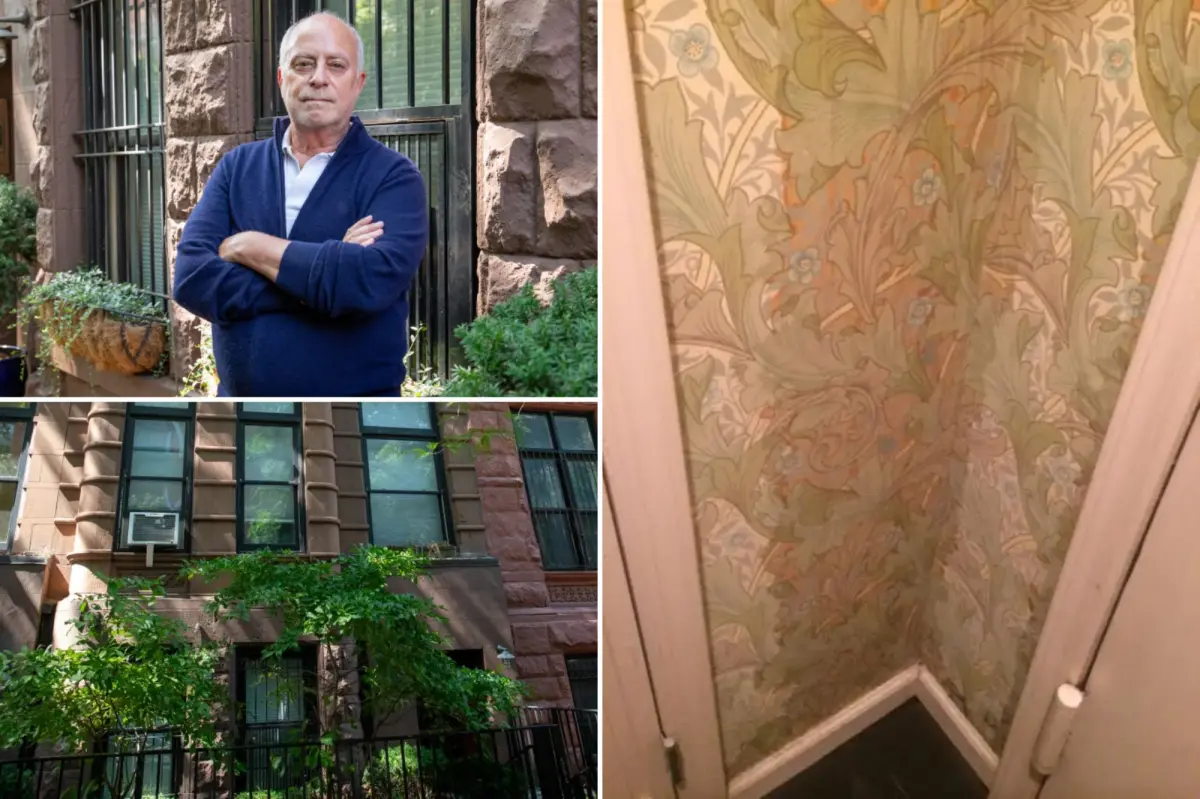
Gary Paul was sitting on the toilet in his Upper West Side studio co-op apartment reading the paper when he claims he noticed brown dirt oozing down his bathroom mirrors. Looking up, he said he saw the crown molding splitting. Then came the sound: water rushing inside the walls, running down the pipes.
Allegedly stemming from a leaky toilet in the unit above, he claims it quickly spread to his first-floor kitchen, flooded the hallway outside with an inch of water, and eventually seeped into the basement.
And it’s all far from flushed away.
What followed was a messy, fingers-pointed-every-way legal battle at 108 W. 87th St. It’s nine years later and the fight is still ongoing.
“The co-op let the water run for over 18 hours after being notified, as it was a Sunday afternoon, and they thought they’d get to it the next day, with a certain amount of careless lack of duty,” Paul claimed to The Post. “Thousands of gallons poured over my apartment from when it was discovered until mid-day the next day when management arrived, with keys, and a few hours later when a plumber arrived to arrest the flow of water.”
Frustrated, Paul — a design consultant with a Harvard graduate degree — stopped paying his then-$581-a-month maintenance fee and filed a $650,000 lawsuit (later upped to $750,000 upon amending the complaint) in damages alone against the co-op, the building management, the maintenance company (which was subsequently dismissed) and his upstairs neighbors, “because they didn’t give me the money for the insurance and they weren’t remediating the mold,” he claimed.
Ever since, Paul — who no longer owns the apartment — has bounced from rental to rental.
“The case is worth over a million dollars at this point because of the legal fees and diminished fair rental value and [there’s] property damage because there’s a lot of personal property that was damaged too, ultimately,”Paul’s attorney Ian Brandt claimed to The Post.
Among the alleged destruction: hand-printed Morris & Co. foyer wallpaper, which Paul told The Post would cost $13,000 in 2017 to replace. In addition, court records detail allegedly damaged contents, like a Christopher Dresser-designed claret jug from the 19th century, which would cost $2,340 to replace in 2017 figures.
As for alleged structural damage, beyond the split crown molding, Paul added water pooled around the electrical panel — and then inside of it.
The situation went from litigating a $50,000 to $80,000 repair, Brandt said, to between $700,000 or $800,000 in damages today.
The co-op, however, tells a completely different story.
“He’s been a nightmare for us,” co-op president Michael Laba, who claimed Paul has held a bitter grudge ever since he was voted off the board nearly two decades ago, told The Post.
Laba added that management responded appropriately, but Paul, 72, refused to let anyone into his apartment to dry it out, claiming he had severe dust allergies. Laba alleges Paul was actually hoping mold would grow, and ripped out his own stove, tub and drywall just to claim the apartment was destroyed, he told The Post.
The building eventually re-outfitted the unit, but Paul filed a barrage of complaints with city agencies over things like missing smoke detectors, a defective electric panel and unfinished work, complaints — which city records show led to a handful of violations — that Laba told The Post were unfair.
“I filed a complaint for all these things because I was trying to get them to take action to help get the apartment fixed,” said Paul, who referred to himself as “a stickler to rules.” “Whether they did it or I did it, they refused to move forward on the remediation so I could build the apartment.”
Ironically, Paul was on the other side of a mold issue in the building when he was president of the co-op board.
After discovering mold while renovating her apartment in February 2005, a shareholder sued the building etc. in 2006 for failing to “complete the removal of sheetrock from areas of the premises affected or potentially affected by mold,” among other issues, per court documents.
In eerily similar details to Paul’s case, court documents say about the old case: “In opposition, the respondents allege that they properly removed all sheetrock, conducted a visual inspection for the presence of mold and returned to conduct air testing. The respondents further allege that petitioner failed to grant them access necessary to complete the work required under the stipulation, which they are ready and willing to complete.”
Over the latter years of his time at 108 W. 87th St. the co-op found Paul to be “incessantly combative,” according to co-op meeting minutes from Feb. 23, 2018. Paul had emailed Cornerstone Management Systems’ Michelle Greenspan, the managing agent, “no less than 290 times” in what she described as “consistently adversarial” messages, the minutes indicate. Earlier minutes — from the Nov. 21, 2017 meeting — referred to Paul as a “constantly-disgruntled shareholder.” Greenspan, who is not personally a defendant in the lawsuit, declined to comment.
Paul was voted off the co-op board, and as a result Laba alleges Paul “was extremely bitter.”
“That happened 18 years ago. He’s been looking for reasons to sue us,” claimed Laba, who’s been board president for 18 years.
“It’s not a vendetta,” Brandt responded. “It’s someone who’s angry that they lost their home and since 2017 weren’t able to live in it.”
Paul acquired the 400-square-foot apartment in the late 1980s for $100,000, he said — a figure that’s roughly $300,000 today — and spent nearly 20 years on the board.
“It was like a little English hotel room,” Paul said. “I traveled a fair amount, and, for me, it was incredibly affordable. I had places to go for the summers, so I was out of the city quite a bit, and for me it worked.”
The board countersued Paul for unpaid maintenance, and settled by buying the apartment from him for roughly $400,000 in 2025.
When asked for comment, Janet Amidigi, one of the owners of No. 2A that Paul sued — the unit located directly above — said the insurance carrier was handling the issue.
Attorney William N. Candiloros, unit 2A’s insurance defense attorney, said of the saga: “It’s all rather silly because it stems from a simple water leak.”
Read more An 18% City Council pay hike is a middle finger to NYC voters
The management company’s attorney didn’t respond to a request for comment.
The next court date is slated for Aug. 19.

Related Posts

Exclusive | Manhattan rents reach all-time high of $6,655/month amid Mamdani’s rent freeze and pied-a-terre tax threat

Elon Musk to build the biggest building in the world — spanning a colossal 100M square feet