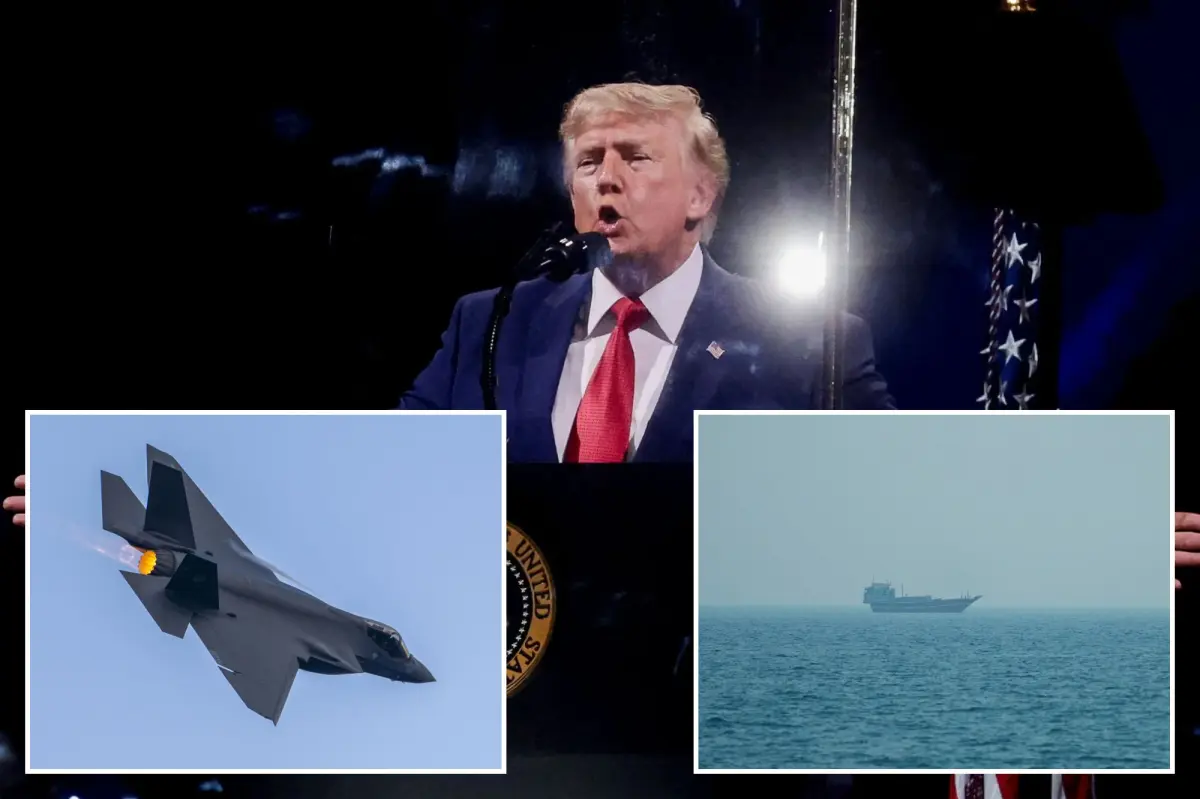
US unloads military might on Iran after Tehran closes Strait of Hormuz: ‘Now they pay’
The US unleashed its military might on Iran after the regime attacked a commercial vessel and declared the Strait of Hormuz closed Saturday.
Read more Mysterious masked man at Ayatollah Ali Khamenei’s funeral revealed
“Iran made a poor choice. Now they pay,” Secretary of War Pete Hegseth posted on X.
The Islamic Republic attacked the M/V GFS Galaxy, a Cyprus-flagged container ship, according to United States Central Command.
A civilian crew member from the ship is now missing and the vessel suffered significant engine room damage in the strikes, CENTCOM added.
Iran also targeted other ships navigating the strait, and the US shot down several drones, an official told the Wall Street Journal.
The US vowed that Tehran would pay a “heavy cost” and said that the retaliation, which began at 7:15 Eastern Time, was being carried out under the direction of the commander in chief, President Trump.
“Iran was provided yet another opportunity to demonstrate adherence to the Memorandum of Understanding after being held accountable for earlier attacks on commercial vessels but has again failed,” CENTCOM said in a statement on X.
Several Iranian military installations were targeted in the strikes, including ground-to-air missile launchers, drone and missile storage facilities and launch sites, and surveillance radars, a US official told Axios’ Barak Ravid.
Explosions were heard in the southern Iranian coastal cities of Bushehr Chabahar and Asaluyeh early Sunday local time, Iranian state-run media reported.
Iranian state media claimed that military buildings were hit in the Busehr strikes, and a military site in Deyr was also hit.
There were also strikes in the city of Kagan, which is near Iran’s vital South Pars oil and gas field, and in Jask, according to the New York Times.
Additional strikes were reported deeper inside Iran, including in the city of Kerman, which is 300 miles away from the coast, CNN reported.
The regime responded to the fierce US retaliation by launching a missile and drone bombardment on America’s Gulf allies, including the United Arab Emirates.
Follow The Post’s coverage of the war in Iran:
- New satellite images show signs Iran may be trying to rebuild suspected nuclear facilities
- Iran holds crisis talks in Oman as US issues Strait of Hormuz demand
- Iran’s Supreme Leader Mojtaba Khamenei vows revenge for killing of father
- Trump warns US military will ‘destroy all areas of Iran’ in the event he’s assassinated by regime: ‘1,000 Missiles Locked and Loaded’
“The UAE’s air defenses are currently engaging with missile attacks and incoming drones from Iran,” The UAE’s Ministry of Defense posted on X.
Iran had earlier warned that US strikes would be met with a “severe” response and that “new enemy bases” in the Middle East would be targeted.
Alarm sirens also rang out in Bahrain, the country’s Interior Ministry announced.
Iran’s Revolutionary Guards Corps (IRGC) claimed to have fired a “warning shot” at the Cyprus-flagged ship, which was traversing an “unauthorized route.”
“Following this incident … the Strait of Hormuz will be closed until further notice and until the end of the American interventions in this area, and no vessels will be allowed to pass through it,” it said in a statement.
Iran’s attack came after the Trump administration issued an ultimatum to Tehran on Friday, demanding that the regime publicly declare that the Strait of Hormuz was open for business and that there would be no further attacks on shipping.
Meanwhile, diplomats from both sides feverishly tried to resuscitate negotiations after Trump declared the cease-fire was off.
“The Islamic Republic of Iran has asked us to continue ‘talks,” Trump posted on Truth Social Friday.
“We have agreed to do so, but the United States has stated to them, in no uncertain terms, that the Cease Fire is OVER!”
Earlier this Saturday, before hostilities erupted, Iranian and Omani representatives met in Muscat to discuss the crucial international waterway.
The two nations weighed a proposal to divide the Strait of Hormuz — through which 20% of the world’s oil supply flows — into two routes.
One route would be under Iranian control and the other would be managed by Oman, CNN reported.
US officials cast doubt on whether a nuclear deal with Tehran would ultimately be reached if the Islamic Republic refused to open the waterway, the WSJ reported.
Enmity between Iran and the United States intensified this week, with Ayatollah Mojtaba Khamenei vowing to avenge his father’s death.
“The criminal, disgraceful murderers of the martyred leader… will carry their dream of a peaceful death in bed to the grave…This vengeance is what our nation is demanding, and this must definitely be done,” he said in a statement Saturday.
Former Ayatollah Ali Khamenei was killed at the outset of Operation Epic Fury in a US-Israeli airstrike.
Trump told The Post on Friday that he has left detailed instructions for Iran’s “obliteration” should the Islamic Republic assassinate him.
“I’ve been on their list for a long time. That’s what we’re dealing with,” he said. “The only thing is, I’ve left instructions — if anything happens, to just literally bomb them at levels that they’ve never seen before,” Trump said.

Related Posts
Harrowing footage shows moment flood hits China-Nepal border — leaving 72 dead and hundreds missing, including 3 Americans

Prince Harry, Meghan Markle and their kids arrive back in the UK