DSA’s primary triumph exposes the movement’s limits — for now
The celebrants at a candidate’s election-night party typically provide a snapshot of their core constituency.
Read more Antisemitism: From New York to LA, a new political scourge
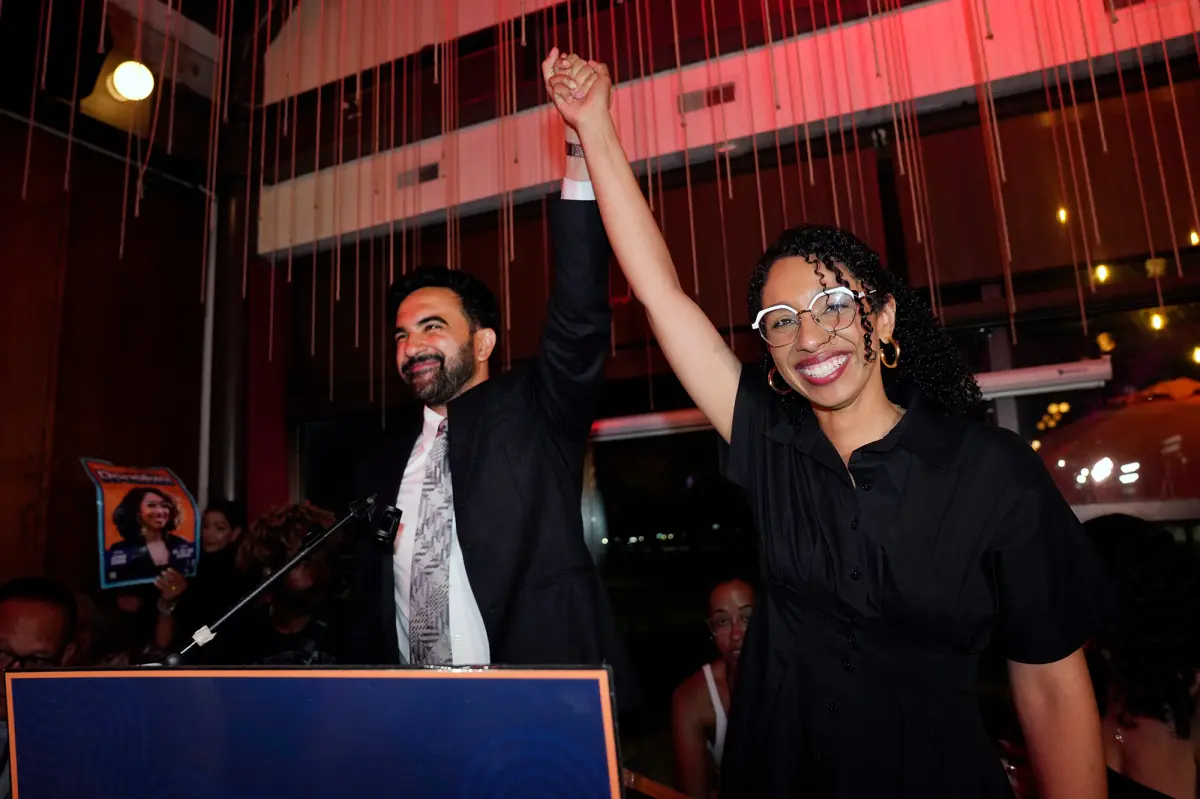
On Tuesday night, overwhelmingly white, young, college-educated New York City transplants gathered in East Williamsburg and Harlem to cheer the Democratic primary victories of Democratic Socialists of America members Claire Valdez and Darializa Avila Chevalier.
Those crowds tell an important story: What appears to be a broad leftist insurgency is, in reality, a more limited political movement — one powered by a narrow demographic base that only exists in meaningful numbers in a handful of neighborhoods across a few of America’s largest cities.
The precinct returns from these races reveal the restricted conditions under which the DSA can currently succeed.
In Manhattan’s District 13, Avila Chevalier performed strongest in precincts with younger residents, higher incomes and larger shares of college-educated voters.
In District 7, Valdez’s largest margins came from East Williamsburg, Greenpoint and Ridgewood, a rapidly gentrifying area increasingly filled with young NYC newcomers.
Despite presenting itself as a revolutionary movement of the urban working class, the DSA’s latest electoral victories expose it as mainly a political vehicle for college-educated urban transplants to repackage their own material anxieties into a narrative of broader social and class struggle.
Valdez and Avila Chevalier personally embody the DSA constituency.
Both candidates share remarkably similar biographies: suburban-raised and college-educated, arriving in New York in their late teens and early 20s to pursue elite-coded education and professions.
In the case of Valdez, her ambition was to become a professional artist; in the case of Avila Chevalier, a college professor.
For both candidates, the waning of those original career ambitions in their late 20s appears to have coincided with their deeper involvement in left-wing activism — and ultimately their recruitment as political candidates.
Unable to become a commercially successful artist, Valdez took a position as a program assistant at Columbia University, where she became active in the union representing other university desk staff.
And for Avila Chevalier, the demands of a PhD program at the CUNY Graduate Center seem to have left plenty of time for the thirty-something doctoral student to return to her alma mater Columbia University and participate extensively in the anti-Israel encampments and protests of spring 2024.
Once the true social composition of the DSA base is understood, its politics appear less revolutionary.
Read more Louisiana pastor Tony Spell’s family claimed neighbor was tormenting them before viral beatdown
They instead resemble a practical, if highly idealistic and naïve, political program tailored to the economic anxieties of urban transplant Millennials and Gen Zers.
Living predominantly in single-person households and often possessing educational credentials with relatively modest earning power, they face extraordinary housing costs, stagnant earnings relative to living expenses, heavy student debt, and a growing frustration that the urban lifestyle they believed their educations would earn can no longer be sustained.
Unsurprisingly, they’re attracted to policies centered on housing affordability, tenants’ rights, student debt relief, white-collar union organizing and an expanded welfare state as a means of making life in expensive cities more manageable.
The DSA can exercise political power only where this demographic exists in critical mass — and where it doesn’t, the movement offers a narrow pathway to Democratic-primary victory.
The failed effort to unseat Rep. Ritchie Torres illustrates the point: Despite intense leftist opposition to Torres over his staunch support for Israel, the movement lacked a large enough base of young suburban transplants — that is, gentrifiers — in his Bronx district to turn DSA frustrations into a successful electoral challenge.
While the DSA’s electoral power remains constrained by specific demographic prerequisites, that doesn’t mean this dangerous movement should be ignored.
Its rise demonstrates how small, highly organized factions can capture low-turnout primaries and exercise political influence well beyond their numbers, as the old urban Democratic machines lose their capacity to centrally manage the party’s local affairs.
But the same conditions that enabled the DSA’s rise could empower other movements as well.
If a relatively small bloc of urban transplants can organize itself into political power, there’s no reason another coalition can’t do the same.
There remains a real opportunity for authentic candidates rooted in these districts — people who built businesses there, raised families there and meaningfully connect to their neighbors — to offer voters a different vision than one crafted by leftist NGO staffers and idealistic college-educated transplants.
The lesson of DSA’s election victory is not that America’s cities have suddenly become socialist: It’s that urban politics are now open to whoever is willing to organize.
Read more Senate Democrat suggests it may be time to replace Schumer and Jeffries: ‘Let others lead’
Alicia Nieves is a columnist for UnHerd.