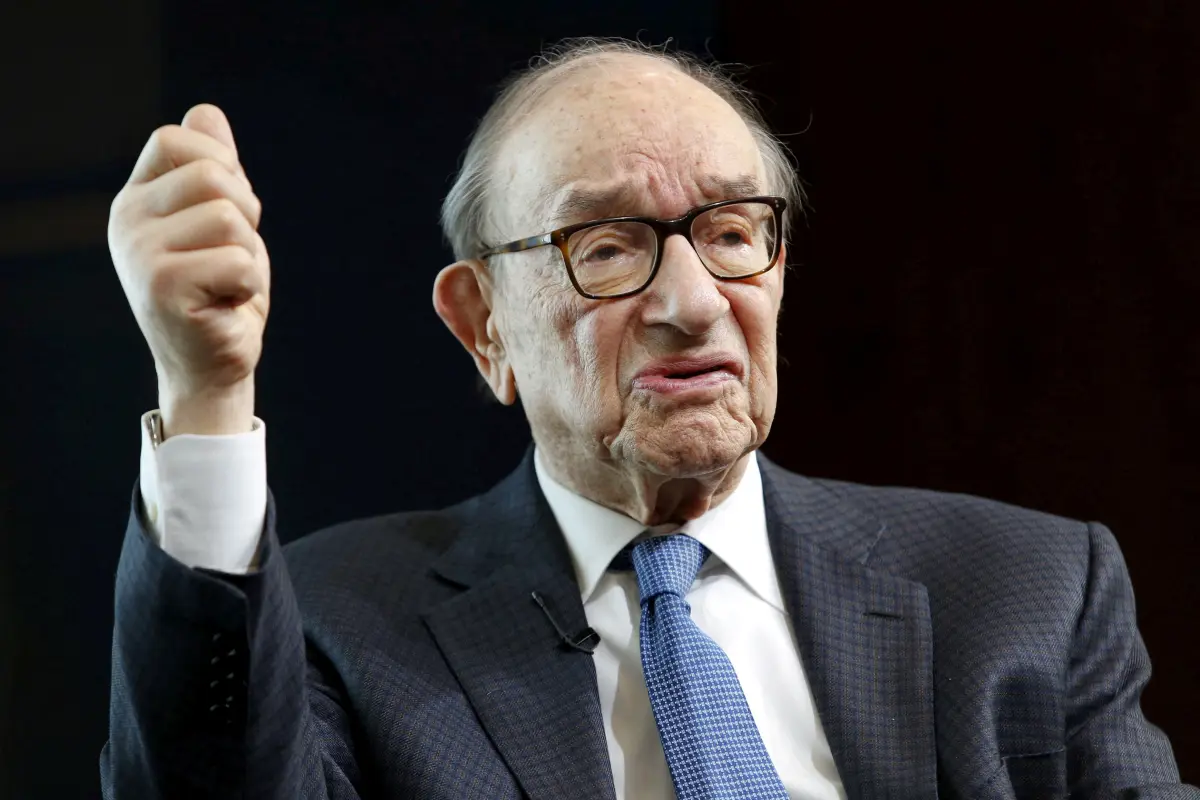
Alan Greenspan fueled America’s boom — and set a course for future prosperity
Alan Greenspan, who died Monday at the age of 100, presided over a two-decade-long period of almost unprecedented American boom and economic dominance that’s now inaptly called “The Great Moderation.”
His long tenure as chairman of the Federal Reserve Board offers invaluable economic lessons that today’s Fed would be wise to heed.
President Ronald Reagan nominated Greenspan as Fed chair in 1987, during his second White House term.
There Greenspan remained until 2006, reappointed by President Bill Clinton and staying through much of George W. Bush’s presidency.
His tenure followed a period of turbulent and often reckless monetary policy at the Fed.
In the tumultuous 1970s, the Fed tried to juice a floundering economy with easy money, pushing inflation to as high as 11% on the eve of the Reagan presidency.
Family incomes crashed in real terms as Americans’ after-inflation incomes shrank.
It was the worst decade for the US economy since the Great Depression, sending the stock market into an extended slump.
Greenspan’s immediate predecessor at the Fed, Paul Volker, is rightly credited with breaking the back of double-digit inflation by taking away the “punchbowl” of easy money.
That helped launch a 40-year bull market on Wall Street and rapid gains in American GDP.
But it was Greenspan who solidified the longer-term victory over inflation, and permanently restored global confidence in the dollar.
During his reign inflation averaged between 2% and 3%.
He operated under the “Volcker rule,” using commodity prices as a forward-looking gauge of inflation to keep prices stable.
And it worked magnificently.
The Reagan expansion that began in late 1982 hit a speed bump with the mini-stock market crash of 1987, but the recovery was swift — and in the 1990s and early 2000s, the economy shot up like an Elon Musk rocket.
So did the stock market: If you put $100 into S&P 500 stocks when Greenspan arrived, that investment was worth more than $900 on his departure 19 years later.
So did family incomes: America became a job-creation machine during Greenspan’s tenure, adding roughly 2 million new jobs on average every year.
But even as growth exploded, Greenspan was ever vigilant against stock-market bubbles.
In one of his most famous speeches, he memorably warned investors in 1996 to beware “irrational exuberance,” fearing that stock values may have been getting ahead of themselves.
Yet the market continued to soar as America came to dominate the internet age, with companies like Apple, Amazon and Google leading the charge — and Greenspan’s low interest rates facilitating the boom.
Greenspan — once an avid follower of the famous libertarian Ayn Rand — wasn’t just an inflation hawk; he also used the Fed’s bully pulpit to browbeat Congress into cutting deficit spending.
It’s no accident that the only balanced budgets in the last 50 years happened when Greenspan was at the helm of the Fed.
That’s the lesson of the Greenspan era: Combine stable prices, lower tax rates, and less regulation with restraints on government spending, and you’ve got the secret sauce for a prosperous America.
The dollar became the unrivaled world reserve currency in the 1990s, and other nations effectively “dollarized” their own currencies to defeat the curse and theft of runaway inflation.
One of the nations that wisely dollarized was China, during its rapid ascent after shifting away from a wholly communist economy toward a market-oriented one.
Inflation remained low until in 2022 Fed chief Jerome Powell allowed prices to flare up to above 9% during Joe Biden’s presidency.
It’s ironic that many economic historians have begun to call the Greenspan era “The Great Moderation” — because all that was really “moderate” during this era was inflation.
In fact, it was the “Great American Boom,” under principles that President Donald Trump is restoring.
Kevin Warsh, the new Fed chair, appears to be a disciple of Volcker and Greenspan, continually touting the policy of a stable dollar.
If he follows their example, more prosperity is right around the corner.
Stephen Moore is a co-founder of Unleash Prosperity who served as an economist in Ronald Reagan’s and Donald Trump’s administrations.
Read more Nets trade for Julius Randle in three-team deal in pre-NBA draft stunner