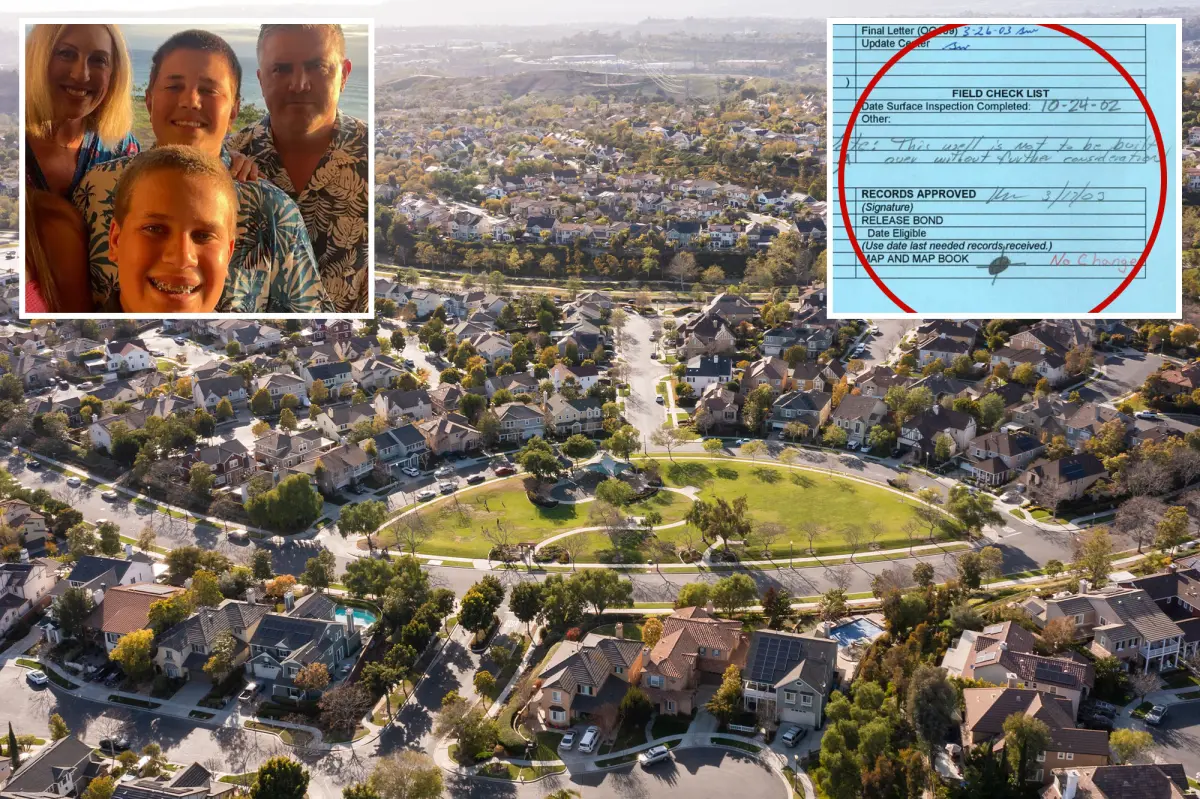
Ladera Ranch childhood cancer mystery deepens after 20-year-old handwritten warning emerges
Officials were warned over 20 years ago not to build on land now struck by extremely rare childhood cancers without “further considerations,” unearthed records show.
Read more Letitia James’ abuses of power laid bare as top prosecutor blows the whistle
The ominous handwritten notes appeared on documents for the abandoning of a historical oil well below what is now Orange County’s Ladera Ranch in California.
The memos have renewed fears about what caused at least six cases of Ewing sarcoma to be diagnosed in the community between 2013 and 2024.
Some worry they have been sparked by pesticides being used on school property, while others have pointed to a landfill site in the area, with health officials still investigating possible links or causes.
The newly emerged notes, which appear twice in pencil markings on the Department of Conservation permit, say: “This well is not to be built over without further considerations.”
The pages of the final report, obtained by the California Post, were signed off by state oil and gas supervisor William F Guerard Jr, acting state oil and gas supervisor Kenneth Henderson and deputy supervisor R.K. Baker when the well was sealed on Feb. 26, 2002.
The memos, which appear to have been scribbled by engineer Floyd Leeson, do not reveal why there should be no building on top of the well nor if any “further considerations” were taken.
In a separate note, with an arrow pointing to the message, it added: “Put on final letter.”
Henderson told the Los Angeles Times in a brief interview he did not recall why they were written on the documents, but suggested “the well plugging may not have been up to the current standards.”
The Department of Conservation told the outlet the notes may have been a “clerical error,” but failed to comment on why it specifically said they needed to be “put on final letter.”
There is no suggestion the abandoned well has sparked the Ladera Ranch cases of Ewing sarcoma, with scientists still unsure exactly what causes it.
But Karen Lincoln, director of the Center for Environmental Health Disparities Research at UC Irvine, said the notes should not be dismissed. “I wouldn’t assume that the statement means the well was known to be hazardous. But I also would not dismiss it.”
She continued, “If an engineer specifically raised a concern about building over a well, it’s reasonable to ask what that concern was and whether it was resolved before homes were built over or around it.”
Lincoln pointed to several possible explanations, saying: “There could have been concerns about the condition of the well, how it was sealed, the materials used to seal it or the possibility that gases or other substances could move through or around the well.”
But the records surrounding the Citrus Lane well need to be examined before drawing conclusions, Lincoln stressed.
Abandoned oil wells can potentially provide a pathway for gases or other substances underground to move toward the surface if they were not adequately sealed or have deteriorated over time, she said.
But she added: “There is an important distinction between a potential hazard and an actual exposure. We need to know whether something is actually being released, whether it is reaching places where people live, and whether people are being exposed at levels that could affect their health.”
Depending on the history of an oil well and surrounding production, potential contaminants can include methane, hydrocarbons, benzene and other volatile organic compounds, Lincoln said.
Read more NYC baseball nuts do 3 MLB games in 9 hours — here’s why they packed a change of clothes
Some of those substances are associated with serious health effects, while some are known or suspected carcinogens. There is no suggestion they specifically cause Ewing sarcoma.
Potential exposure pathways can include outdoor and indoor air, soil gas and, in some circumstances, groundwater.
Lincoln continued: “If a well is underneath or very close to homes, I would be particularly interested in whether gases or vapors could be entering indoor spaces.”
She also cautioned against jumping from the existence of the well and the cancer cases to a conclusion that one caused the other.
“We don’t know that the well is causing harm,” Lincoln said. “But residents are telling us they are concerned about a potential environmental health risk. They deserve a serious, transparent response.”
Ladera Ranch is a wealthy, family-oriented OC community of roughly 24,000 people that began taking shape in the late 1990s on what was once part of the Rancho Mission Viejo cattle ranch.
The current estate, built by DMB Developments, dates to 1997, when plans were unveiled for 8,100 homes. When the first Ladera Ranch homes went on sale in 1999 and by the early 2000s, old oil wells were being abandoned as construction pressed ahead.
Residents have been seeking answers over a cluster that includes cases of Ewing sarcoma, an extremely rare cancer that develops in bones or soft tissue and disproportionately affects children and young adults.
A examining Ewing sarcoma cases in Southern California found geographic areas with unusually high concentrations of the disease and said the findings warranted further investigation into possible environmental risk factors.
The researchers cautioned, however, that “causality cannot be inferred.” For parents in Ladera Ranch, that uncertainty has offered little comfort.
Bonnie Regan, whose son Ryan was diagnosed with cancer, told the Times she had never heard of the disease before her son became sick.
Dustin Matteson, whose son Brody was also diagnosed and later died, said residents deserve to know whether something in their environment could be contributing to the cases.
DeAnn Kling, another Ladera Ranch parent, said she believes potential factors ranged from pesticides in the water to homes and the ground itself.
The California Geologic Energy Management Division (CalGEM) generally advises against constructing buildings over sealed oil wells so officials can maintain access to them and reduce potential leakage risks.
The agency said wells plugged and sealed to current requirements are less likely to leak, but “there is no guarantee.”
The Post reached out to CalGEM, Henderson, DBM Developments and health officials for further comment.
Download The California Post App, follow us on social, and subscribe to our newsletters
California Post News: Facebook, Instagram, TikTok, X, YouTube, WhatsApp, LinkedIn
California Post Sports Facebook, Instagram, TikTok, YouTube, X
California Post Opinion
California Post Newsletters: Sign up here!
California Post App: Download here!
Home delivery: Sign up here!
Page Six Hollywood: Sign up here!
Read more NYC nurse still wearing scrubs killed in caught-on-camera hit-and-run crash