I quit my 11-year job after the Seattle Times killed my Sophie Cunningham column — read it here
I really wanted the column to run. I didn’t think it would, but I felt obligated to try to get it in.
Toward the end of last month, before the Seattle Storm hosted the Indiana Fever, I spoke to people attending a rally in support of Sophie Cunningham outside Climate Pledge Arena.
The Fever guard had recently taken a stance against biological males competing in women’s/girls sports, and a few dozen folks showed up to express their gratitude for her position.
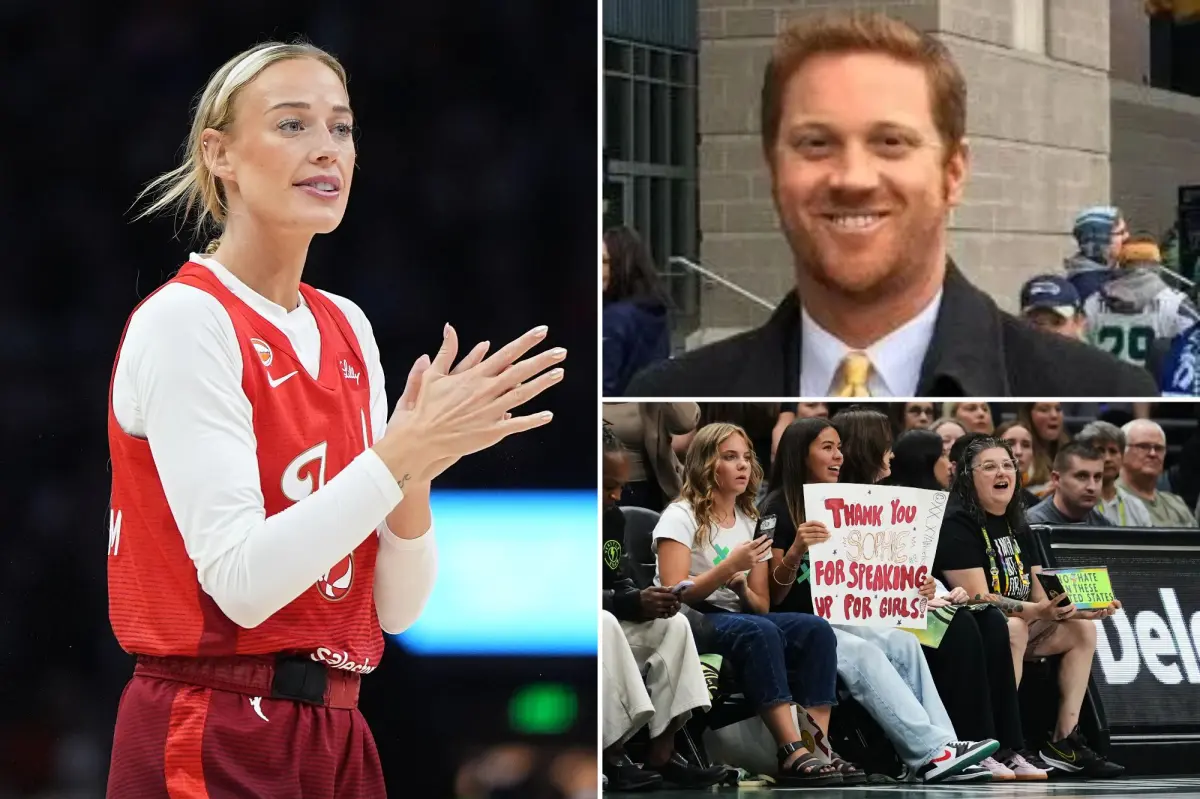
One of them was 16-year-old Ahnaleigh Wilson, who’d lost to a biological male in a track and field race in eighth grade and was holding a sign reading “Thank You Sophie for Speaking up for Girls!”
I didn’t know if I was going to write something at that point, but after she allegedly got cussed out by a Storm co-owner during the game, I felt like I had to weigh in.
One thing Wilson emphasized to me at the rally was that she wasn’t anti-trans. Another student-athlete named Frances Staudt — who said she’s endured daily verbal abuse after refusing to play against a biological boy in a basketball game — echoed Wilson’s sentiment.
So that was the thesis of my column (which you can read here or below) — that supporting the separation of biological females and males doesn’t automatically make you transphobic, so let’s stop throwing those labels around.
I sent a draft after talking to my editor the morning of Friday, July 31, telling him there was no rush to run it. He told me later that day that he and others were looking at it, but that it wouldn’t be ready for Sunday’s paper.
Monday night, I got an email saying that his boss was hoping to talk to the top two newsroom editors about it on Wednesday. No feedback had been given to me. Thursday afternoon, my editor informed me that it wasn’t going to run because I didn’t tell him I was doing this in advance. I didn’t buy this reasoning. If that were the case, the piece would have been killed on the spot, not passed through the hands of multiple editors over several days.
My response? To resign on the spot.
That may come off as an emotional decision, but it was exactly what I was prepared to do. This, after all, was one of several columns of mine that had been spiked at the Seattle Times.
One was a piece questioning whether players for the US Women’s Soccer Team were really the victims of discrimination in their equal-pay lawsuit. Another was a more general column on cancel culture in sports. The last, written shortly after George Floyd’s death, implored people to listen to state-champion basketball coach Mike Bethea — a black man urging the public not to stereotype cops. The common theme? All of these challenged prevailing newsroom narratives and likely would have triggered the outrage mob.
I’ve always thought that it was a columnist’s duty to generate discussion on the most hot-button issues. To avoid such topics was to leave the reader shortchanged. I guess in the end, I just didn’t feel like I could do my job properly anymore.
Right now, I’m in the tenuous position of trying to defend my resignation without sounding like a malcontent. So let me say — I’m very grateful for the 11 years I had at the Seattle Times. The talent there is immense, and the editors let me have a lot of fun with other stories. I also realize where the brass is coming from. The mob is frightening and does not forget. Lots of seemingly brave souls have submitted once activists got their hooks in them. If I had more people depending on me, perhaps I’d act similarly.
But in thinking about this decision, I kept going back to an Albus Dumbledore line: “We must all face the choice between what is right and what is easy.”
To be honest, I’m scared sh–less right now. I have no idea how the next few months or years are going to play out. But that fear beats the indignity of being muzzled.
The plan for now is to keep writing in this space. Maybe that will spawn a new career, or maybe I’ll be a dental assistant in two years. I genuinely don’t know.
All that’s certain is that I’m done holding back. The best things in life are free — speech being at the top of the list.
Matt Calkins is a former sports columnist for The Seattle Times. He now writes on Substack at mattycee.substack.com.
You can read his full column below:
Some people saw bigotry. I saw bravery.
I saw a teenage girl speaking up on an issue that so many adults shy away from.
About 90 minutes before the Storm played the Fever last Tuesday, 16-year-old Ahnaleigh Wilson stood at a rally outside Climate Pledge Arena wearing an XX-XY Athletics shirt while holding a sign reading “Thank You Sophie For Speaking Up For Girls!” It was a nod to Fever guard Sophie Cunningham, who has recently come out against trans females competing against biological ones.
There were no slurs hurled. No malice detected. It was just Wilson, an Eastmont High student in East Wenatchee, demonstrating what some have trouble accepting: that agreeing with Cunningham’s position does not make you transphobic.
“I don’t hate trans people and I have nothing against them,” Wilson said. “I just think that girls should have their own sports.”
Two things can be true at once. You can show compassion for people who feel trapped in the wrong body while acknowledging they have a biological advantage. After all, why do we separate males and females in sports in the first place?
It’s not due to the potential awkwardness of physical contact. It’s because men have higher testosterone levels and different skeletal and muscular frames, which together produce significant performance advantages. This isn’t something I bring up at dinner parties, but it’s undeniable. By every measurable metric in sports — whether it be 100-meter times, vertical leaps, weightlifting, yards off the tee, etc. — the top males substantially outperform the top females.
In short: The separation is strictly for the sake of girls and women. So surely one can see why, to many, allowing biological males to compete against females undermines this division.
Wilson started speaking out after she finished second to a trans athlete in the mile at a Junior Olympics track meet two years ago. Before Tuesday’s Storm game, she said that most of the in-person feedback she’d received had been positive — that the real vitriol was online.
Well, all that changed a couple hours later in the arena, where Wilson sat courtside with her “Thank You Sophie” sign in hand.
During the game, Storm co-owner Celeste Keaton walked over to Wilson, allegedly called her “f***ing insane,” added “I hope Jesus can forgive you,” and supposedly brought her to tears. This happened after a fan pointed to another Sophie supporter and yelled “garbage! Take the trash out!”
It’s been a category 5 hurricane since, with Keaton receiving a five-game suspension, J.K. Rowling and Cunningham showing Wilson support on X, and pundits from every corner of the internet dissecting the scene.
I suppose I could make this about the WNBA and its steady habit of garnering the wrong kind of attention. But I’d rather stick to the issue of who should be allowed to participate in women’s sports. This is what Wilson comes to rallies for — not international drama.
One common counterargument against her and Cunningham’s stance is that biological men in women’s sports is rare, so why make a fuss?
OK, but if something is wrong, why should it matter how rare it is? Are opponents saying that if the amount of trans athletes reaches a certain number, then we should address it? To me, this is almost a tacit admission that there is, indeed, something unfair occurring.
Plus, how rare is rare? Trans swimmer Lia Thomas won the national title in the women’s 500 meters while at Penn. Trans cyclist Veronica Ivy set a world record in the 200 meter sprint for her age group. Trans weightlifter Laurel Hubbard won silver at the 2017 World Championships and in 2020, became the first openly trans person to compete in the Olympics.
Here in Washington, trans track athlete Veronica Garcia, representing East Valley High in Spokane Valley, won the 2025 state title in the 400 meters. In Oregon, McDaniel High’s Ada Gallagher won the 2025 state title in the 200 meters. In California, Jurupa Valley High’s AB Hernandez won the 2025 state title in the high jump and triple jump. This doesn’t mean trans athletes have overtaken women’s sports completely, but the list goes beyond the examples above.
Another counter is that trans people are more vulnerable than most, and barring them from sports could be emotionally devastating. I’m not unsympathetic to this. Two points, though. First — who’s to say that a biological girl wouldn’t also feel distressed if displaced by a trans athlete or forced to share a locker room with a biological male? Second and more importantly, this is about fairness, not feelings. The unfortunate truth with this issue is that someone is going to be disappointed — either the biological female who feels she’s unreasonably disadvantaged, or the trans athlete who can’t participate. This debate is simply about who it should be.
Come November, Washingtonians can vote on an initiative that, if passed, would preclude biological males from competing against females in school sports. And though one might think this will increase open dialogue on the matter, we all know this is one of the more frightening topics to address.
Even if polling suggests that most of the country sides with Cunningham and Wilson, nobody wants to be called a bigot or a transphobe.
Such attacks are what Tumwater High student Frances Staudt says she endures every day at school. Two Marches ago, Staudt refused to play basketball against a biological male from Shelton for fear of being injured. She added that the biological male’s presence in her locker room made her feel uncomfortable.That hasn’t spawned much sympathy from certain peers.
“I have people at my school cussing me out. I have people using some pretty awful words toward me as well. I’ve had people say ‘F-You, Frances,’ and ‘I hope you choke and die,’ Staudt said. “But I know ultimately I’m doing the right thing…this whole thing isn’t about hate.”
So it’s not an anti-trans movement? I asked Staudt.
“There’s only so many times that I can say that what we are standing up for is not ant-trans,” she said. “This is pro-women’s sports.”
This doesn’t mean that there aren’t bigoted or transphobic supporters of this position. But what if we withheld these labels until absolutely sure? Most people, I think, want to do what’s right. They just have different opinions on what right is.
We saw that at Tuesday’s rally, which included protesters who came to denounce the pro-Cunningham event. In one of their hands was a sign that read “No Hate in WA State.”
It was supposed to be a shot at the Sophie supporters, but I don’t think it landed. Something tells me that Ahnaleigh Wilson saw that and thought “I couldn’t agree more.”
Read more Miss Grand USA Mekyla Li stripped of title after alleged hit-and-run, previous marriage revelations