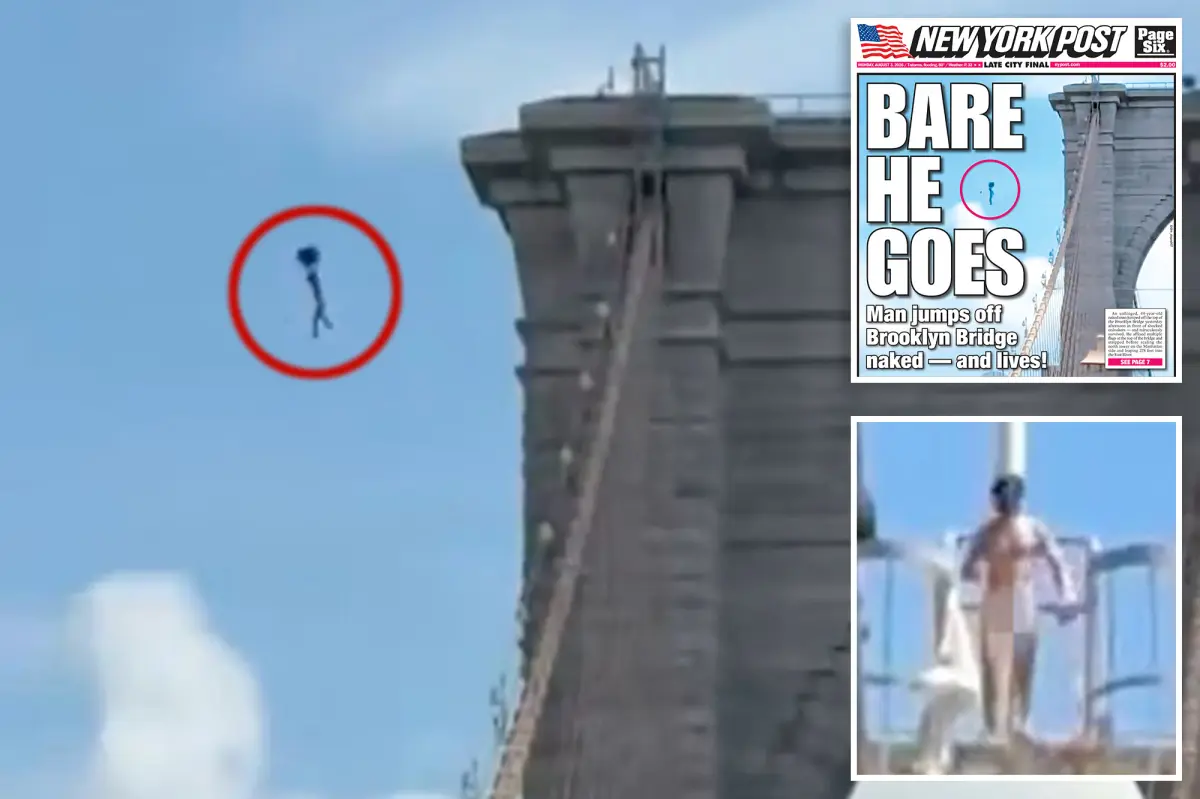
The surprising reason why Brooklyn Bridge naked nutjob may have survived ‘overwhelmingly fatal’ plunge
The miraculous survival of a disturbed man who leaped from the Brooklyn Bridge on Sunday could have come down to a handful of factors — the likeliest being the precise position of his body when he landed in the East River, an expert told The Post.
“Jumping or falling from extreme heights – such as a 270-foot bridge tower – is overwhelmingly fatal,” said Dr. David S. Shapiro, a trauma surgeon with more than 30 years of experience.
“It generates extreme kinetic energy that causes widespread, life-threatening trauma,” added Shapiro, who now works at New England Donor Services.
Incredibly, cops said the 44-year-old jumper, identified as Galymzhan Abaildayev, is in stable condition after his 278-foot leap from the top of the Brooklyn Bridge, which Shapiro said could be attributable to several variables, though not many of them likely.
The bag Abaildayev was carrying could have served as a “makeshift parachute” that reduced his descent speed just enough to spare his life before he crashed into the water’s surface, which Shapiro said was likely at a speed between 79-87 mph.
Another remote possibility is that an object such as a rock could have fallen just ahead of Abaildayev, disturbing and thereby slightly softening the surface of the water, reducing the impact on his body.
Shapiro points out that there’s absolutely no evidence that either of those conditions existed, noting Abaildayev’s best, and most likely chance for survival was his body’s position when he entered the water.
“If you slap your hand on the water palm down, it makes a big splash … if you hit it vertically like a karate chop you’ll see it slice through the water. The position your body is in when it enters the water makes a big difference.”
He made the comparison to cliff-divers, who position their bodies so that they are able to hit the water at speeds up to 60 mph before coming to a near dead stop.
“They don’t head-first dive. If you lock your body in, perfectly straight vertically, you’ll go through the water a lot easier,” he said.
Shapiro said trauma centers refer to injuries suffered by people who fall from a height as “deceleration” injuries – similar to how if someone suddenly hits a brick wall when they’re driving a car, their body is thrown forward and rapidly goes from a high speed to 0 mph.
“Modern airbags aren’t just cushions, they blow up then instantly release so it slows you down but doesn’t stop you because you want to slow someone down rapidly, but not instantly.”
Read more Trump’s path to reopening the Strait of Hormuz may run through Oman
As for the types of injuries that would be typical in a patient who had endured such a fall, Shapiro said they ran the gamut.
“I’d expect things like internal injuries – particularly what we call lacerations — of the spleen and liver – as well as skeletal, joint or bone injuries. If you land on your feet, your heel bone, one of the highest-impact bones in your body, it can cause a complex ankle fracture on both sides,” he said.
He said the massive femur bones could also be injured, and that the cascading effect of the kinetic energy transmitting from the legs could also fracture the pelvis.
Since both the femurs and pelvis sit near major blood vessels, Shapiro said a fall-type injury can cause severe vascular injuries.
“’Vertical injuries’” – where someone lands directly on their feet or head – can cause a variety of trauma, including burst fractures of the spine and at the base of the skull, injuring both the brain and spinal cord,” he said.
“Survival in rare instances requires an extraordinarily precise alignment of factors: reduced descent velocity, ideal body orientation, and immediate access to trauma care to mitigate lethal internal hemorrhage,” he added.
“People in this setting can die from the impact, drowning and injuries that may not seem immediately lethal but result in significant bleeding, brain trauma, and other injuries that together are enough to cause death in most.”
Abaildayev was quickly fished out of the river by Harbor Unit cops and rushed to Bellevue somehow in stable condition. He was since charged with reckless endangerment, making graffiti, public lewdness, criminal trespass and disorderly conduct, police announced Monday.
Although he was listed in stable condition, Shapiro points out that he’s not necessarily out of the woods just yet.
“You can also have a fall and survive and die days or weeks later from other injuries,” he said.
Read more Mets send Clay Holmes, Tyrone Taylor to Cubs in massive trade

Related Posts

NYPD cop, mom of three dies after boob job in Dominican Republic, family demands malpractice probe

Exclusive | Naked nutjob in miracle jump off Brooklyn Bridge is Kazakhstan activist who plotted plunge on birthday: roommate