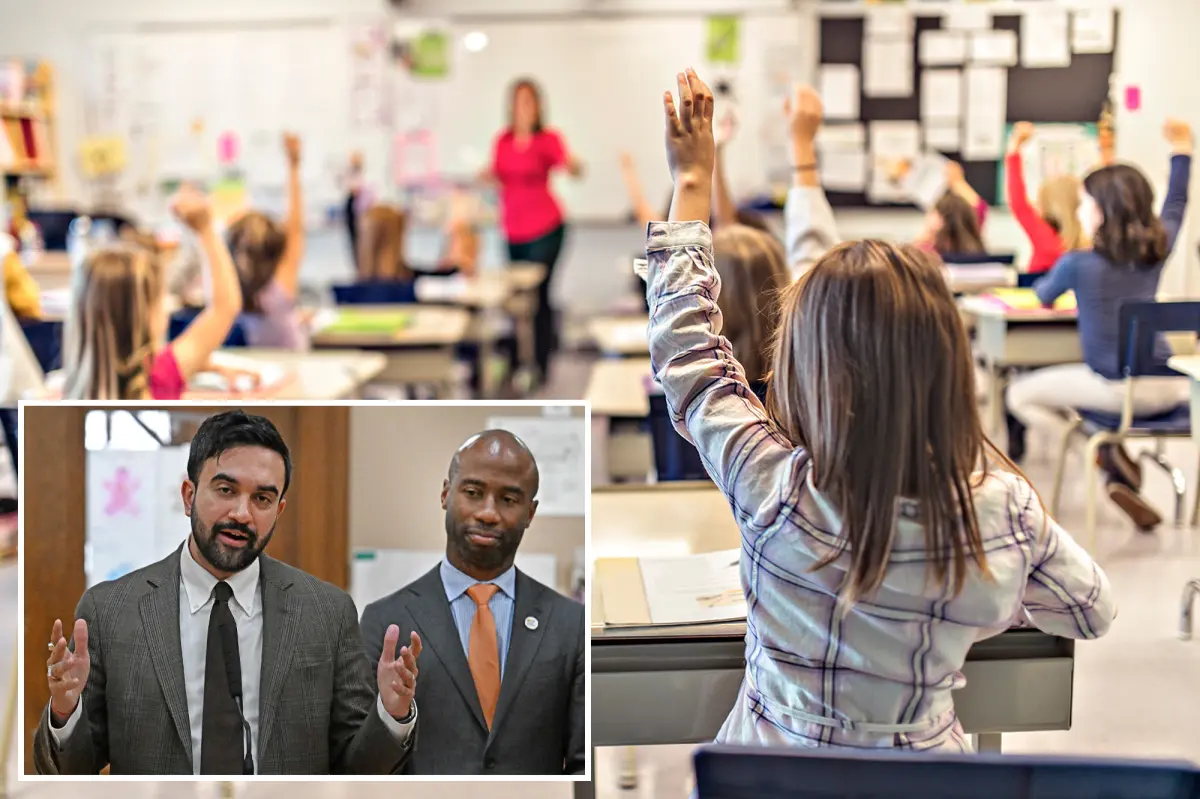
Staggering 900 NYC public schools failing students amid grade inflation, lax accountability
Welcome to New York’s flunking factories.
Failure in the city’s public education system has become “normalized” — and even bolstered by grade inflation and fixing — with nearly half of schools consistently failing their students, a bombshell new report found.
The sweeping analysis, conducted by the Success Academy Charter Schools network, found that in those 906 public schools, fewer than half of students passed math, reading, or both, on state exams last year.
In total, a staggering 43% of the system’s approximately 912,000 students are in these failing schools, according to the shocking report released Tuesday.
Of the 906 schools, a majority of students in 503 of them failed both math and reading.
About a third of the 906 schools have appeared on state “accountability” lists since 2012, and some have been designated as failures for decades, the analysis found.
Instead of attacking the 5-alarm fire, the stinging indictment claims city and state policies have only worsened the situation by failing to address the scandal or trying to hide it.
“These are not accidents. They are the product of a system that has chosen, year after year, to protect itself rather than serve its students,” the report, titled, “By Any Honest Measure,” said.
“Imagine a hospital where more than half of patients died from routine procedures. A fire department that failed to respond to more than half its calls. A municipal water utility that delivered contaminated water to more than half its residents, or air traffic controllers whose lack of oversight regularly resulted in massive casualties.
“No other public institution would be permitted to operate in this way.”
But the level of failure in the nation’s largest public school system “has been normalized — and, worse, systematically obscured.”
Follow live updates on Mayor Zohran Mamdani’s socialist agenda and the latest in NYC politics
Success Academy head, Eva Moskowitz, said the report marked the most extensive review to date of consistently low-performing schools.
The report also accused New York policy makers and educators of actually rewarding failure — including by pumping more funds into low-performing schools with dwindling enrollment.
New York City spent $40 billion on public education in 2024 — $36,293 per pupil, double the national average of $17,619.
Lawmakers pump more money into the failing schools, to more than $40,000 per student, the report found.
According to the analysis, 34% of elementary students attend failing schools, with that percentage going up to 49% for middle schoolers and 62% for high schoolers, based on test scores.
In many cases, students are routed from a failing elementary school to a failing middle school to a failing high school.
Many high school graduates are unprepared for college-level work and have to take remedial courses when enrolled in CUNY’s community colleges, the report noted.
The problem would be worse if not for grade inflation — and the accountability system for both students and teachers is a joke, the analysis charged.
The student grading policy measures effort, participation, and attendance — but excludes performance on the state’s standardized math and English exams.
Using state test scores as part of a student’s grade was scrapped by the Panel for Educational Policy under then-Mayor Bill de Blasio.
Read more Iran fires missiles at commercial ships in Strait of Hormuz: report
It means nearly all students who score poorly on state exams end up getting good grades and are promoted.
Meanwhile, state policy forbids using student test scores to evaluate teachers. Therefore, nearly all teachers receive satisfactory ratings.
The report noted: “98% of teachers [rated] effective. 43% of students failing. The math doesn’t add up.”
The state Education Department also comes under severe criticism — for repeatedly lowering benchmarks to boost passing rates on its math and reading exams, the report said.
The manipulation is exposed when students score much lower on the federal government’s National Assessment of Educational Progress exams, considered the gold standard for testing.
Albany has participated in downplaying or covering up failure, the report charges.
The state no longer releases its own comparisons on standardized test results by traditional public versus charter schools, as the latter on the whole perform better on the exams.
But state lawmakers are also blocking entry into alternative education programs, such as higher-performing charters, by imposing a cap on the number allowed to open.
A decade ago, the state Legislature also approved a law striking the phrase “persistently failing school,” changing the term to “persistently struggling.”
The biggest wasteful folly: state lawmakers and Gov. Kathy Hochul’s approval of the class size reduction law in New York City.
The legislation — passed at the behest of the powerful United Federation Teachers president Michael Mulgrew — comes despite enrollment in city public schools dipping by 123,000 students since 2020, the report said.
The city Department of Education failed to consolidate or close schools after a decade of enrollment decline, the report said.
The struggling and failing schools already have lower class sizes because families abandoned them, and the report said evidence doesn’t support the mandate setting classroom caps. Of the roughly 900 failing schools cited in the report, 167 were woefully under-enrolled.
Another budget drain is the city Department of Education’s commitment to “propping up schools” with plummeting enrollment.
More than 800 schools out of the roughly 1,800 in the system have fewer than 400 students, while 241 had fewer than 200 students enrolled.
The politicians have contributed to the problem by holding such schools “harmless” — maintaining their level of funding despite them having fewer students.
“Failing schools rob children of their futures,” the report said. “Under-enrolled schools drain the budget for no return.
“The class size mandate will spend billions more on schools where class size is already low — and where it has demonstrably not helped,” it adds. “New York City cannot afford any of this in the midst of a significant educational crisis.”
The report suggested that the state make test data more readily available; tie teacher and school evaluations to students’ results; stop manipulating state tests and end grade inflation and curb wasteful spending, among other recommendations.

Related Posts

Exclusive | The wacky — and dangerous — NYC bills that could soon be law: Sick leave for pets, abolished gang database and an elephant ban
Cause of death revealed for missing US Assistant Attorney found dead in San Diego office